Inside the Martech Shift: Why Agentic AI and RAG Architectures Will Redefine Customer Experience
As marketing rapidly evolves, the convergence of artificial intelligence and enterprise data is redefining how brands connect with customers and scale growth. At the intersection of martech and marketing operations, this shift is driving a new era of precision, automation, and measurable impact—where AI-powered systems don’t just support campaigns, they orchestrate them. From optimizing engagement to enabling large-scale personalization, the fusion of agentic AI and enterprise data is transforming marketing from an operational function into a strategic growth engine.
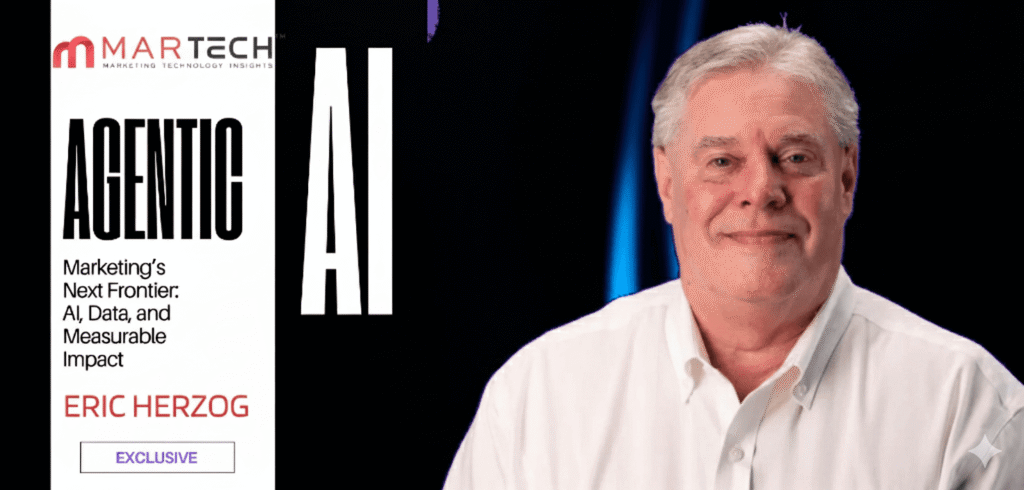
Few leaders embody this transformation more than Eric Herzog, CMO of Infinidat, whose track record in enterprise storage and marketing innovation places him at the forefront of this shift.
In this exclusive Q&A with MarTech Insights, Eric explains how agentic AI, powered by Retrieval-Augmented Generation (RAG) architectures, is transforming customer engagement—and why data-driven storytelling, rooted in measurable outcomes, is becoming the new currency of brand credibility.
Recommended MarTech Insights:
The Hidden Cost of Signal Loss (And the Fix Marketers Need Now)
MarTech Insights: What are your predictions for how enterprises will incorporate agentic AI tools to boost customer engagement and support large-scale marketing strategies?
ERIC HERZOG: It does not take a crystal ball to say that the adoption of agentic AI by enterprises is soaring. Enterprises have figured out that agentic AI can be used to automatically respond to inquiries about the company and its products and services – and it can do it at scale. Customers and prospective customers will rely on information from AI agents, so it’s vital that the information that these AI agents provide is both accurate and contextually relevant.
Because of the potential and promise of agentic AI to make information sharing more dynamic when people engage with the company – whether at the beginning of the buying process or at the point of a buying decision – I predict that enterprises will be compelled to turn to a storage-led RAG AI architecture to support the strategy for sales and marketing purposes.
Marketing leaders will demand near-100% accuracy of information from agentic AI as the company’s interface to the outside world. This will put high pressure on CIOs to deploy a RAG AI architecture, like the one that Infinidat offers. RAG stands for Retrieval-Augmented Generation, and it is basically a way for generative AI to leverage internal, private databases with an organization to obtain the most accurate and relevant data in real time to answer queries.
RAG AI enables enterprises to auto-generate better quality, more accurate, more informed and more reliable responses to user queries. The quality of it will directly affect the brand and customer engagement. I predict that marketing leaders will need to learn about RAG AI architecture, the same way they would learn about a marketing automation platform, even if it’s the IT team that deploys.
Read More MarTech Stories:
IAB Tech Lab Launches AI CoMP Group for Publisher Monetization Standards
Infinidat was recently awarded a Best of Show award for the Most Innovative Artificial Intelligence (AI) Application at the 2025 FMS: The Future of Memory and Storage conference. Our industry-acclaimed InfiniBox G4 platform, coupled with our AI RAG reference architecture, delivers an enterprise storage capability that uniquely ensures the accuracy and contextual relevance of AI models to answer queries autonomously
Just as fast as agentic AI is incorporated into an organization’s go-to-market strategies, a RAG AI architecture will have to be implemented to be the foundational underpinning of this exciting new technology for transforming the customer experience online.
MarTech Insights: How do you use data-driven storytelling to promote Infinidat’s Enterprise Data Storage Solutions?
ERIC HERZOG: At Infinidat, we demonstrate strong data-driven storytelling with the use of facts and figures about how Infinidat’s best-in-class enterprise storage solutions deliver business value to organizations and service providers worldwide. For example, one of our most compelling data-driven stories is that Infinidat’s InfiniBox platform pays for itself in only 11 months and delivers an ROI of 162%.
This is incredible for enterprises that install Infinidat’s award-winning primary storage platform for their data infrastructure.
Another set of attention-worthy data-driven stories we articulate is around Infinidat’s guarantees.
We are so confident in our enterprise storage solutions and our next-generation data protection solutions that we offer guarantees that most of our competitors would not even dare to offer. We guarantee that the snapshots are fully immutable, and recovery time (RTO) is one minute or less on our InfiniBox system, regardless of dataset size, and 20 minutes or less, regardless of dataset size, on our InfiniGuard system, which is our purpose-build-backup-appliance that works with all major backup vendors. Our data-driven storytelling makes it all come to life.
Last, but not least, we utilize data-driven storytelling for our green IT strategies, which we call E2 for environmental and economic advantage. Our green IT approach focuses on reducing energy consumption and lowering carbon emissions, while enabling our customers to achieve significant efficiency gains and reduced OPEX.
We evolved our sustainability-by-design philosophy last year with a new generation of systems: the InfiniBox G4 platform. With 20% more power-efficiency per controller CPU core and up to 2.5x better performance than the 3rd generation. Overall, InfiniBox is more energy-efficient than competitors. Infinidat arrays deliver 2.8 to 6.9 times better power efficiency (watts/TB) compared to our enterprise-class storage competitors.
For example, a Fortune 500 financial services company replaced 288 floor tiles of a competitor’s all-flash array from a competitor with 61 floor tiles of Infinidat’s InfiniBox SSA all-flash array. Talk about saving watts, slots, power, floor space, CAPEX, and IT human resources. This type of data-driven storytelling illustrates how Infinidat’s solutions reduce environmental impact while improving efficiency and reducing costs. It has helped boost Infinidat to the forefront of the IT industry as one of the top enterprise storage solution providers in the world today.
Thank you, Eric, for the insights. We look forward to our next round of conversations.
Future Outlook: The Imperative of AI-Driven Marketing Excellence
Editorial note:
Enterprises navigating the next frontier of marketing and customer experience face a landscape where the fusion of agentic AI with data-driven architectures like RAG is no longer optional—it’s imperative.
Eric Herzog’s insights underscore that success in this landscape hinges not only on adopting cutting-edge technology but also on ensuring accuracy, relevance, and measurable outcomes at every customer touchpoint. From automating engagement to crafting compelling, data-backed stories, marketing leaders who embrace this approach will position their brands at the forefront of innovation, efficiency, and trust in a hyper-connected world.
Frequently Asked Questions: FAQs on Agentic AI, RAG, and Marketing
What is agentic AI, and why is it important for marketing?
Agentic AI refers to AI systems that can autonomously perform tasks and interact with users in a human-like manner. In marketing, it enables scalable customer engagement, real-time responses, and more personalized experiences, all while maintaining brand consistency.
How does the RAG (Retrieval-Augmented Generation) architecture improve AI performance?
RAG allows generative AI to access private, internal databases in real time, ensuring that responses are accurate, relevant, and contextually aligned with the company’s knowledge. This is critical for marketing teams to deliver trustworthy information to customers.
3. How can marketing teams leverage data-driven storytelling effectively?
By combining verified data points, business metrics, and customer outcomes, marketing teams can create narratives that demonstrate ROI, product impact, and operational value. Data-driven storytelling builds credibility and supports informed decision-making.
What role does sustainability play in enterprise data strategies?
Sustainable IT, like Infinidat’s E2 approach, reduces energy consumption and carbon footprint while improving efficiency and lowering operational costs. Marketing teams can integrate these stories into campaigns to highlight corporate responsibility and innovation.
How should enterprises prepare for integrating agentic AI into marketing operations?
Enterprises should establish a strong foundational architecture (like RAG), educate marketing leaders on AI capabilities, and prioritize accuracy and context in all customer-facing interactions. Collaboration between IT, data, and marketing operations is essential for success.
Marketing Technology Insights: Aurora Mobile’s GPTBots.ai Expands Global Reach With New Data Center Options
For media inquiries, you can write to our MarTech Newsroom at sudipto@intentamplify.com