The Endless Scroll We Can’t Resist
You open your phone for a “quick scroll.” Five minutes, you promise. Forty-five minutes later, you’ve laughed at memes, saved recipes, and read half a news article – yet can’t remember why you started. That’s not an accident. Its design.
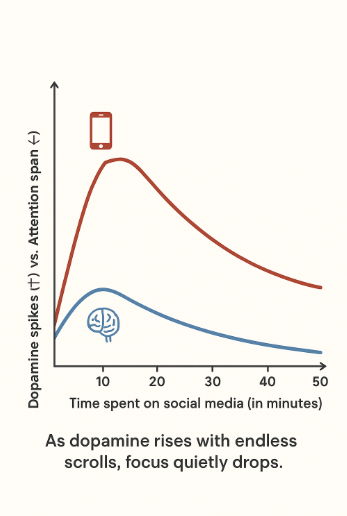
Today, our attention is the most valuable currency online. Social media platforms use intermittent rewards– the same psychological trigger that powers slot machines. Each swipe might bring something funny, interesting, or emotional. That may keep your brain hooked, waiting for the next hit of dopamine- the feel-good chemical that drives motivation.
According to a Gartner Digital Engagement Report 2024, 64% of consumers admit they “lose track of time” while scrolling, underscoring how effectively digital content captures continuous attention.
The Dopamine Loop: Why We Crave “Just One More”
According to Harvard Business Review (2024), people check their phones about 150 times a day. Most sessions last under two minutes but add up to several hours. Each moment delivers small bursts of satisfaction that train our brains to expect fast rewards.
The infinite scroll, introduced in 2006, removed natural stopping points. Combined with AI-powered algorithms from platforms like Salesforce, Adobe Experience Cloud, and HubSpot, every feed now learns what keeps us glued to the screen. Each post is personalized to our behavior, timing, and interests – so we keep scrolling without thinking.
It feels effortless because it is meant to be.
McKinsey’s Digital Consumer Trends Report 2025 notes that personalized content increases user dwell time by 40%, but decreases their task-switching efficiency by 20%.
How Instant Gratification Rewires Focus
From a marketing view, this design is brilliant. From a human view, it’s worth reflecting. Instant rewards are exciting, but they can also train the brain to crave quick results and lose patience for long-term goals.
A Stanford University study (2024) found that users who watched short-form videos for more than 30 minutes had 25% lower focus in later tasks. The brain, flooded with constant novelty, begins to find slower activities – like reading, deep work, or learning – less rewarding.
We start to prefer scrolling for the dopamine effect that hits over doing something that takes time but offers deeper satisfaction.
Ethical Marketing: Designing for Minds, Not Addictions
Marketers now face a choice: design to hook attention or design to earn it. Ethical marketing focuses on value-based engagement – content that informs, inspires, or solves problems rather than exploiting impulse.
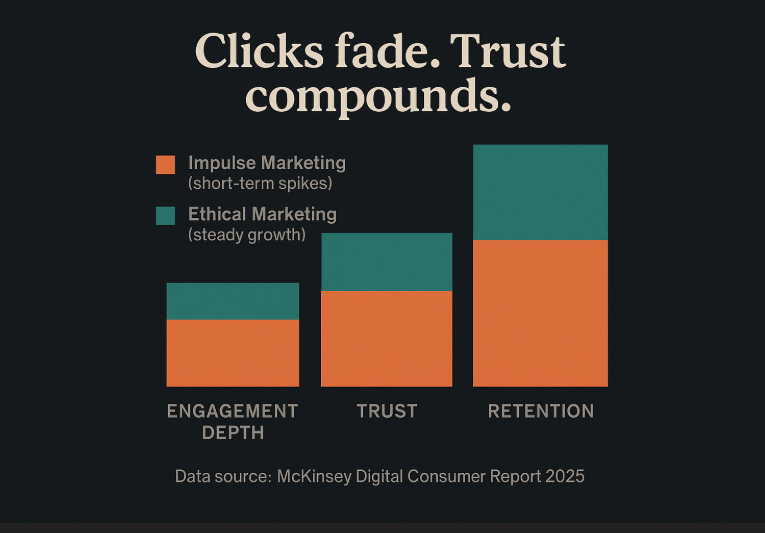
Modern tools like HCL Unica and SAP Emarsys already use emotional analytics to measure the quality of engagement, not just clicks. And it pays off. According to McKinsey’s 2025 Digital Consumer Report, brands using ethical personalization see 30% higher trust and stronger customer loyalty.
The future belongs to marketers who respect attention as a limited, human resource – not an infinite one.
McKinsey’s 2025 Digital Consumer Report reveals that companies practicing ethical personalization experience 30% higher consumer trust and 20% stronger brand loyalty compared to purely engagement-driven models.
From Hooked to Aware
Instant gratification isn’t the enemy; it’s human nature. But awareness is power. The next time you catch yourself endlessly scrolling, pause and ask: Is this adding value – or just filling time?
And if you’re a marketer, ask the same of your campaigns. Because in the dopamine economy, empathy might just be your strongest competitive edge.
Conclusion
Instant gratification isn’t inherently bad – it’s part of how our brains work. But awareness separates control from compulsion. Every scroll, click, or like is a choice between curiosity and habit. For users, it’s about mindful engagement. For marketers, it’s about creating value, not addiction. In the end, empathy-driven design isn’t just ethical – it’s the smartest, most sustainable way to earn lasting attention.
FAQs
1. What is instant gratification in marketing?
It’s the drive to deliver immediate digital rewards, such as likes, views, or fast content.
2. Why is scrolling addictive?
Because unpredictable content triggers dopamine release, it reinforces the habit.
3. How can marketers use it responsibly?
By designing content that educates or inspires instead of exploiting attention.
4. Does it affect focus?
Yes. Studies show that excessive exposure to short content reduces concentration and patience.
5. What’s next for ethical marketing?
AI tools that balance personalization with well-being and long-term trust.
Discover the trends shaping tomorrow’s marketing – join the leaders at MarTech Insights today.
For media inquiries, you can write to our MarTech Newsroom at info@intentamplify.com.