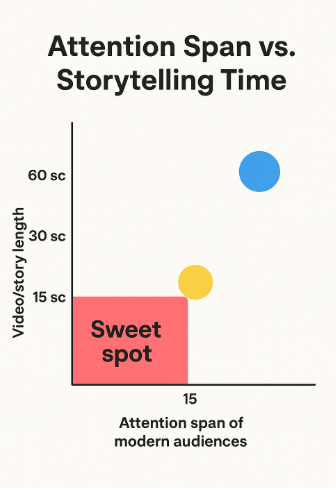
Short-form narratives of just 15 seconds have become the new storytelling norm in a world of fast technology and limited attention spans of about eight seconds. It is as if the clock of time is running against you as a marketer, a tech enthusiast, or even a busy professional, making storytelling within 15 seconds your next superpower. What short-form narratives manage to do is to get the attention of the reader, allow emotional attachment between them and the product, and imprint a lasting memory all within the time the scroll of the next post button is pressed.
Why 15 Seconds Matter
Studies come to the conclusion that short-form content or video, in particular, has a much more potent effect on engagement and recall than lengthy formats. The 2025 HubSpot “State of Marketing” report says that people have a preference for brief micro-moments, which give them both insight and emotion in a fast way.
Gartner predicts that by 2025, 70% of customer engagement interactions will rely on short-form storytelling for brand recall and decision-making.
Brands using marketing technology must realize this: a well-driven tool or campaign is pointless if the audience cannot be brought to feel or understand the narrative within the first seconds of it.
What if it were a cybersecurity promotion? Normally, we could expect a fifteen-minute video explaining in detail what a network breach is, how it happens, and what products can stop it. However, what if it was just a 15-second clip? A quick shot depicting a network breach (Hook), a security team intercepting it in real-time (Moment), and finally, the product logo with a tagline (Resolution). It is such a pity that we do not have 15 more seconds to really explain what just happened but I guess the idea is that this is just enough time to share the story, to actually, quickly, gauge the urgency, trust, and capability of the situation, sneakily and effectively, without bombarding the viewer with technical details that would have otherwise been too daunting and just skipped.
The Structure of a 15-Second Story
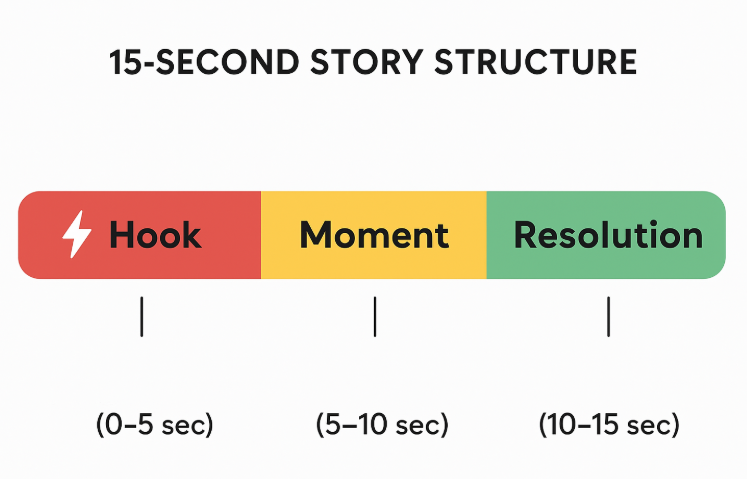
Most successful micro-storytelling uses an uncomplicated plot:
- Hook (0–5 sec): The hook should be a moment that resonates with the viewers or something that astonishes them and thus grabs their attention.
- Moment (5–10 sec): Show the core action or change that is happening.
- Resolution (10–15 sec): Connect back to the brand and give the viewer a call-to-action.
Such a short format attracts the attention of the target audience without boring them with too many details. In a world of limitless scrolling, being clear and immediate is everything.
Why It Works
Stories stick. The chances that a person will remember a story told to him/her are 22 times higher than that of a single fact being recalled (Higo Creative). Short-form stories fit in perfectly with people’s content consumption habits. Content is mostly accessed via mobiles, the consumer is usually on the go, and explanations are rarely longer than a few sentences, as the consumer’s patience is quite limited. When emotional appeal merges with brand communication, marketers have a better chance to pull in consumers, enhance brand recall, and, in turn, increase brand loyalty.
Operationalizing Micro-Storytelling
The use of marketing technology is one of the ways in which brands make the scaling of these stories not only possible but also quite efficient. Instruments designed for dynamic creative optimization, AI-driven video personalization, and performance analytics provide a platform brand with an opportunity to easily change the story for different social media channels, LinkedIn, Instagram, and TikTok, without making the central storyline incoherent. Keeping an eye on the metrics like the rates of view-through, brand lift, and engagement is an assurance that such programs give a measurable output that goes beyond simple click counts. McKinsey shows 71% of consumers expect personalized interactions – and top‑performers generate about 40% more revenue through those experiences.
Conclusion
It is no longer just a trend; the act of telling a story in 15 seconds has become a marketing imperative. Through combining structure, feeling, and technology, brands have the power to win over their audience, generate real connections, and leave an everlasting imprint. How your brand is remembered by your audience might very well be determined by the next 15 seconds. McKinsey reports 53% of advertisers now use 5 or more commerce‑media networks – a sign that multi‑touch micro‑stories are spreading fast.
FAQs
Q1. What makes a 15-second story effective?
A 15-second story highlights a relatable character or moment, emotionally or functionally resonates with the audience, and quickly connects to the brand.
Q2. Which tools support these campaigns?
Dynamic creative optimization, AI-driven video generation, personalization engines, and analytics suites.
Q3. How to measure success beyond clicks?
One can measure success beyond clicks by tracking completion rates, shares, brand recall, sentiment, and downstream conversions such as leads or demos.
Q4. Can micro-stories work across all platforms?
Yes, but you should tailor the pace, visuals, and tone according to LinkedIn, Instagram, TikTok, or OTT channels.
Q5. How often should stories be refreshed?
Check your engagement data regularly; for intensive campaigns, refresh every 4–6 weeks while ensuring consistency by retaining the core narrative.
Discover the trends shaping tomorrow’s marketing – join the leaders at MarTech Insights today.
For media inquiries, you can write to our MarTech Newsroom at news@intentamplify.com