Why do some short videos go viral and get millions of views, while others just quietly disappear in the scroll? It all comes down to brain chemistry. The thing is, every time you see something amusing, surprising, or exciting online, your brain sends out dopamine – a “feel-good” neurotransmitter associated with pleasure and motivation. According to McKinsey & Company, “valuable attention” (not just time spent) is the key driver of media performance in the attention economy.
Marketers call this phenomenon the dopamine effect – and this is the reason why short-form videos are the leaders on platforms like TikTok, YouTube Shorts, and Instagram Reels. They are quick to give the user an emotional reward, which makes the user want to come back for more.
The Science Behind Viral Short Videos
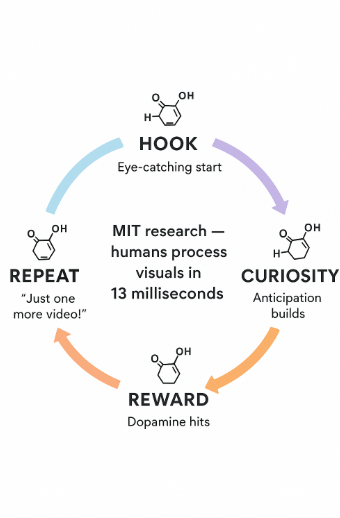
Humans are wired to want their gratification to come quickly. Researchers at MIT have found that people are able to understand what is shown in an image even if it is only for 13 milliseconds. That is faster than the eye’s blink. Short videos do this by offering very quick visual payoffs, thus keeping the dopamine flowing.
This is the way it operates:
- Hook: A visually or emotionally striking thing in the first two seconds gets the attention of the viewer.
- Curiosity: The brain expects a reward and therefore stays connected.
- Payoff: A punchline, a surprise, or an emotional moment leads to the release of dopamine – the feeling of being satisfied.
Platforms are making it possible for users to keep watching without interruption, thereby creating a cycle of users who keep on viewing “just one more” video.
How Marketers Tap into the Dopamine Loop
Smart brands do not use short videos to manipulate users but rather to connect with them. This is the way they accomplish it:
- Lead with emotion: Use a relatable situation or a question to start the communication – “Ever wonder why your coffee tastes better on Fridays?”
- Shake hands with the world in mere seconds: People recall the stories far more than the slogans. Even a 10-second “before-and-after” moment can generate empathy. McKinsey research found that consumers in the U.S. and globally now spend roughly 13 hours a day engaging with media (all devices combined).
- Make a reward: Use an end with humor, surprise, or value. The emotional payoff is what the brain stores.
- Keep it lively: Rapid changes, movement, and sound transitions keep the viewer’s attention and facilitate the call.
HubSpot states that short-form videos are the most effective in terms of ROI across social channels. To be precise, users are 2.5 times more likely to share these videos than any other content type.
The Ethical Edge: Connection, Not Addiction
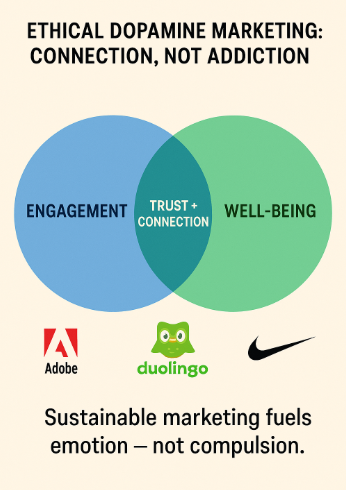
Objective, however, is not to confine audiences – but to render experiences impactful. Quick educational reels by Adobe are a means to ignite creativity, whereas Duolingo employs humor to make language learning a pleasant experience. Both approaches drive engagement through dopamine — but they build trust, not dependency. Gartner, Inc. predicts that 50% of consumers will significantly limit their social-media interactions by 2025.
The Takeaway
Short videos happen to be viral not by chance but by their very nature. They stimulate the brain’s inherent desire for stimulation, reward, and connection. Top marketers utilize this fact to formulate content, which is pleasurable to watch – not because it is manipulative, but because it is emotionally true.
Correctly executed dopamine marketing is not only capable of grabbing attention but also of acquiring loyalty. Learn more about how Emotional Triggers That Make Short Videos Go Viral.
Conclusion
The dopamine effect is not just a marketing buzzword; it explains scientifically why short videos prevail in the digital world. Every scroll, swipe, and share is a result of the brain’s craving for quick, rewarding experiences.
The real opportunity for marketers is to use this knowledge in an ethical manner – to create content that excites, informs, and uplifts. When short videos bring real value through emotional storytelling, they are not mere dopamine triggers; they facilitate trust and long-term connection.
In today’s attention economy, brands that understand not only what the brain sees but also how it feels will be the ones leading the conversation. The smartest marketing acts not only as a visual grabber but also as a stimulator of emotion, memory, and loyalty.
FAQs
1. What is the dopamine effect in marketing?
It is the way brands stimulate the brain’s reward system by providing emotional and fast-paced content.
2. Why are short videos more effective than long ones?
They are able to instantly satisfy, thus keeping dopamine levels high and engagement steady.
3. How can marketers responsibly handle dopamine?
By coming up with value-driven and positive content rather than launching manipulative “clickbait” that misleads users.
4. Which industries can gain the most from short videos?
All, with a particular accent on eCommerce, entertainment, education, and lifestyle brands.
5. Is dopamine marketing the future?
Yes, but with the emphasis on connection rather than compulsion. Those brands that evoke emotions in people will always be the winners of attention.
Discover the trends shaping tomorrow’s marketing – join the leaders at MarTech Insights today.
For media inquiries, you can write to our MarTech Newsroom at info@intentamplify.com.