Marketing technology has moved far beyond its early role as a set of campaign tools. Today, it functions as a core layer of enterprise infrastructure.
Platforms that once supported email marketing or CRM workflows now orchestrate complex customer journeys across digital channels. AI models analyze behavioral signals.
Data platforms unify fragmented customer insights. Automation systems influence how brands engage buyers at scale.
Yet, the success of MarTech is not defined by technology alone. It depends on the strategic decisions behind how these systems are designed, governed, and applied inside organizations.
As companies rely more heavily on data-driven marketing and AI-powered engagement, a leadership perspective is becoming just as important as technical capability.
Across marketing operations, revenue strategy, customer experience, and product innovation, women leaders are contributing influential viewpoints on how marketing technology should evolve. Their approach often extends beyond tools and automation.
They focus on customer trust, responsible data use, and the long-term relationship between brands and their audiences.
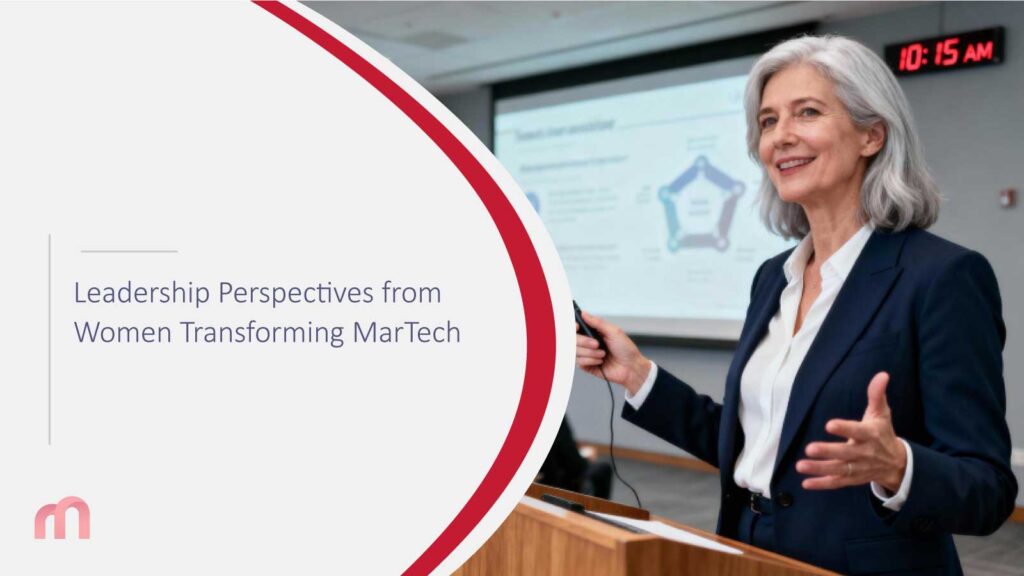
Leadership Perspectives from Women Transforming MarTech
As marketing technology reshapes how organizations engage customers, leadership perspectives are becoming as important as the platforms themselves.
Women leaders across marketing operations, data strategy, and revenue teams are influencing how MarTech evolves to support both growth and customer trust.
The Market Inflection Point for Marketing Technology
Marketing technology is expanding faster than most enterprise software categories.
According to the 2024 Chief Marketing Officer Survey from Deloitte, marketing budgets have rebounded to around 10.1 percent of total company revenue, with a growing share directed toward digital infrastructure and marketing technology platforms.

“The uncertainty about the election and its aftermath is looming large in people’s minds,” Professor Christine Moorman of Duke University’s Fuqua School of Business said.
“They know there will be winners and losers in the marketplace depending on tariffs, inflation-reducing strategies, and consumer confidence.”
Marketing is no longer simply a communications function. It increasingly operates as a data-driven revenue engine supported by complex technology systems.
Yet the rapid growth of MarTech has introduced new tensions inside organizations. Technology capabilities are expanding faster than governance models.
Data volumes are increasingly faster than teams can operationalize insights. Automation is scaling faster than many companies can ensure responsible oversight.
The result is a leadership challenge as much as a technical one.
Market Reality. What the Data Actually Shows
Across marketing operations, revenue strategy, and digital transformation roles, women leaders are increasingly shaping how organizations navigate this transition.
Their influence often centers not only on adopting new platforms but on redefining how those platforms should support long-term customer relationships.
The scale of the MarTech ecosystem illustrates both its opportunity and its complexity.
Data fragmentation remains a major operational barrier. Salesforce research shows that only 31 percent of marketers are fully satisfied with their ability to unify customer data, underscoring the challenge of integrating insights across complex marketing technology environments.
Enterprise organizations continue to struggle with adoption and integration. Organizations are investing heavily in marketing technology, but many lack the operational maturity required to use it effectively.
This gap between capability and execution is where leadership perspective matters. Technology stacks may be purchased centrally.
Their success ultimately depends on how teams structure data governance, decision making, and customer engagement strategies around them.
Economic and Operational Impact
For enterprise organizations, the expansion of MarTech is no longer a purely marketing decision. It affects budgeting, procurement models, and cross-functional collaboration across revenue teams.
However, larger technology investments also introduce operational complexity.
Operational complexity is also increasing as MarTech stacks expand. Organizations are managing larger volumes of customer data while integrating multiple engagement platforms across the marketing lifecycle.

Ann Lewnes, former Executive Vice President and Chief Marketing Officer at Adobe, has been widely recognized for her influence in modern marketing leadership. She was ranked among the world’s most innovative CMOs by Business Insider and named one of the most influential marketing leaders by Forbes.
According to Lewnes:
“The term ‘customer experience’ won’t exist in the organization of the future. It will be so deeply entrenched in a company’s product, process, and culture that it will be synonymous with the brand and represent the only way to do business.”
Her idea reflects a broader reality for enterprise marketing teams. Access to marketing tools is rarely the primary challenge. The harder task is building the operational discipline required to translate those technologies into consistent and meaningful customer experiences.
Women leaders across MarTech strategy, revenue operations, and customer experience are playing a visible role in shaping these conversations. Their focus often centers on the long-term sustainability of marketing technology strategies rather than the short-term adoption of new tools.
In an environment where technology decisions influence brand trust, regulatory exposure, and revenue growth, that leadership perspective is becoming increasingly valuable.
FAQs
1. Why Is Leadership Perspective Important in Marketing Technology Strategy?
Leadership perspective determines how MarTech platforms are implemented, governed, and aligned with business outcomes. Strategic leadership helps organizations translate technology investments into measurable customer engagement and revenue growth.
2. How Are Women Leaders Influencing the Evolution of MarTech?
Women leaders are helping shape MarTech strategy through roles in marketing operations, data governance, customer experience, and revenue operations. Their influence often focuses on responsible data use, integrated customer insights, and long-term brand trust.
3. What Challenges Do Enterprises Face When Scaling MarTech Platforms?
Common challenges include fragmented customer data, underutilized technology capabilities, integration complexity across multiple systems, and a shortage of skilled marketing operations and analytics professionals.
4. Why Is Customer Data Integration Critical for Modern Marketing Technology?
Integrated customer data enables organizations to build unified customer profiles, deliver consistent cross-channel engagement, and generate actionable insights that support personalization and revenue growth.
5. What Skills Are Most Important for Modern MarTech Leadership?
Key capabilities include data strategy, marketing operations management, AI governance, customer experience design, and the ability to align marketing technology investments with enterprise revenue objectives.
Discover the trends shaping tomorrow’s marketing – join the leaders at MarTech Insights today.
For media inquiries, you can write to our MarTech Newsroom at news@intentamplify.com