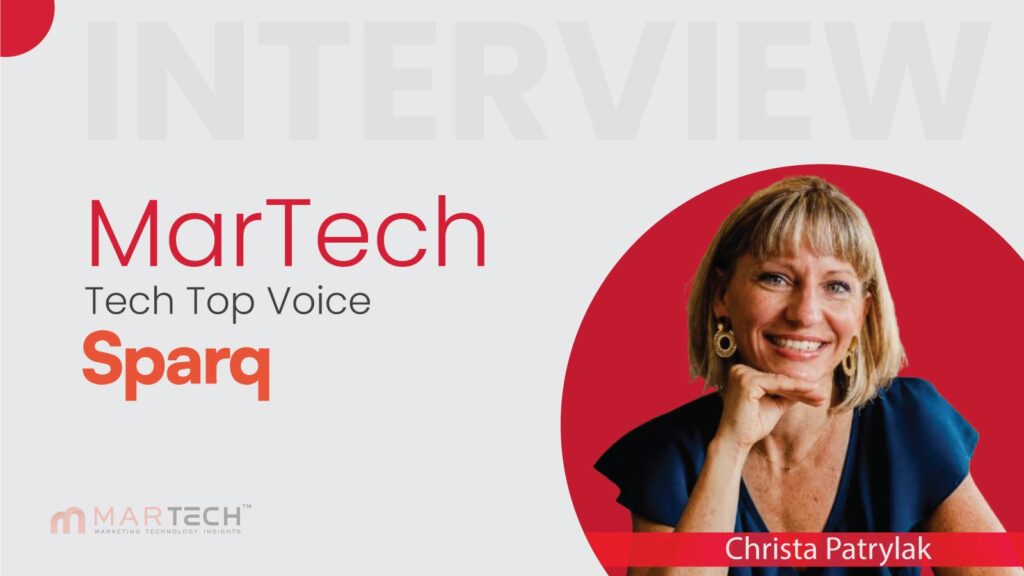
Today’s MarTech Top Voice: Sparq, Chief Marketing Officer, Christa Patrylak.
Welcome to the MarTech Top Voice Interview Series, where we spotlight visionary marketing leaders redefining how technology, data, and AI power enterprise growth. I’m Sudipto Ghosh, your host, and in this edition, we’re exploring how modern CMOs are evolving from brand storytellers to systems architects in an AI-driven world.
Today, I’m joined by Christa Patrylak, Chief Marketing Officer at Sparq. Christa’s career spans iconic consumer brands and transformative enterprise organizations, including leadership roles at HBO and Compass, where she led marketing through major business model shifts and digital transformation. Today, she brings that blend of premium brand rigor and operational discipline to Sparq helping enterprises operationalize AI without destabilizing the core systems that drive growth.
In this conversation, we’ll dive into what it truly means to build marketing systems with engineering-level rigor, how CMOs must redefine their mandate in 2026, and why AI adoption is less about tools and more about infrastructure, culture, and operational backbone. We’ll also explore how marketing can evolve from campaign execution to a living, adaptive growth engine one that behaves more like software than a megaphone.
Christa, it’s a pleasure to have you here.
Let’s begin by talking about how your journey from premium consumer brands to enterprise AI has shaped your philosophy on modern marketing leadership.
MarTech Insights (MTI): Your career spans premium consumer brands and now enterprise technology. How has that blend shaped your philosophy on modern marketing leadership—especially in an AI-first world?
Christa: My career started in iconic consumer brands, where the bar was brutally clear. If people didn’t love the experience and want to share it, you lost. The experience had to earn attention. I’ve carried that mindset into enterprise tech and never believed B2B buyers want anything less. They’re still people, and they still expect experiences that feel relevant, interesting, and effortless.
What genuinely excites me is that AI finally makes that standard possible at scale. For most of my career, we wanted to be this responsive and personal, but we couldn’t be. It was too manual. Too slow. Too expensive. We were stuck running campaigns when we really wanted living systems. Now we actually get to build those systems.
Marketing can listen, adapt, and learn in real time. It can improve itself and behave more like software or a product than a megaphone and honestly, that’s the most energized I’ve felt about this craft in years.
In an AI-first world, we’re designing experiences rather than pushing messages. When it’s done right, customers don’t experience it as marketing at all. It just feels like an extension of the product or service.
MTI: You joined Sparq at a time when marketing leaders are expected to drive both brand trust and revenue velocity. What did your first 90 days reveal about the role marketing must play in enterprise transformation today?
Christa: My first 90 days confirmed something I’ve believed my whole career: marketing can’t sit on the sidelines of transformation. It has to help lead it. Teams don’t change because they agree with a slide. They change because they believe there’s a better way forward, and they can see themselves in it.
At Sparq, it was clear the market had already outgrown the old delivery models. AI can provide a head start rather than a blank slate, and that kind of shift needs clarity, confidence, and momentum. That’s where marketing comes in.
Our job is to translate possibility into belief. Marketing is successful when we make the future feel tangible and exciting enough that customers actually want to step into it.
MTI: You’ve described marketing systems that “operate with engineering-level rigor.” What does that actually mean in practice, and where do most marketing leaders get this wrong?
Christa: When I talk about rigor, I’m really talking about building marketing that customers find irresistible. The kind where they feel deeply understood, and the value is so clear it doesn’t feel like marketing at all. You don’t earn that trust with a one-off launch or a clever promotion. You earn it by doing the unglamorous foundational work most teams would rather avoid – such as, unifying your customer data, integrating your tech, listening closely to the voice of the customer, and building AI into systems that actually learn, predict, and improve over time.
The hard part is the balance. Quick wins and shiny ideas are tempting because they create immediate momentum and visibility. They make marketing leaders popular in the short term, but without strong foundations, that momentum never compounds. It stalls, and you end up running faster just to stand still.
The most meaningful growth comes from the slower, quieter work that rarely gets applause, but changes how the entire system performs. So for me, rigor really means craftsmanship. It means designing experiences so thoughtfully, and supporting them with the right data and AI-powered systems, that customers feel understood before they even raise a hand. When you get that right, that’s when growth becomes inevitable.
Recommended MarTech Insights: MarTech Top Voice Interview with Vibhor Kapoor, Chief Business Officer at AdRoll
MTI: How do you personally define the CMO’s mandate in 2026?
Christa: The CMO’s mandate in 2026 is to be an operator first. Not just the voice of the brand, but the person responsible for building the system that makes growth actually work. In an AI-driven world, adaptability is a stronger predictor of success than expertise. None of us can rely on what we already know. We have to be willing to learn, experiment, and evolve as quickly as we ask our teams to. That means investing in new skills, being honest about what isn’t working, and creating a culture where learning from mistakes is part of the job.
Technology has always changed marketing, but this moment feels different because it’s not just the tools that are evolving – it’s the operating rhythm. We’re now blending human judgment with data and AI in real time, which means marketing becomes a living system that is constantly adjusting and improving. The CMO’s role is to design that system and build a team that can run it together.
At the end of the day, growth only happens when the foundation can support it. When systems can handle more complexity, more intelligence, and more scale without breaking. I see the mandate as creating clarity, alignment, and momentum across the business, making sure that how we talk about value matches how we actually deliver it.
MTI: At HBO, you embedded lifecycle marketing into how the organization operated rather than treating it as a campaign function. What’s the structural difference between those two approaches, and why does it matter for retention?
Christa: Before HBO NOW, everything in marketing revolved around launches. We planned around premieres, pushed hard in the weeks leading up to them, and then moved on to the next show. Success was viewership, press, and buzz. It was moment-based – and honestly, we didn’t even have visibility into how people actually consumed HBO, because we didn’t own the data.
HBO NOW changed that overnight. For the first time, we could see what people watched, when they dropped off, what kept them engaged, and how those behaviors tied directly to subscription and revenue. That data forced us to rethink everything. We stopped marketing shows and started building relationships with subscribers.
Structurally, that meant marketing couldn’t be a campaign team anymore. It had to be built into how the business operated every day. We unified data across silos, partnered deeply with product, hired CRM and analytics talent, and moved to an always-on model that continuously tested and adapted based on behavior.
Take Game of Thrones. The premiere was still a huge cultural moment, but it stopped being the end goal. Every spike in attention had to drive HBO NOW acquisition, then carry through into retention once the season ended. A premiere gets someone to sign up, but what happens the next day and the next week determines whether they stay.
When the lifecycle is built into how the business runs, retention becomes a byproduct of how you operate, rather than a bet placed on the next big launch.
MTI: You’ve led marketing through major business model shifts—HBO’s move to direct-to-consumer and digital transformation at Compass. What separates marketing leaders who successfully navigate that level of organizational change from those who don’t?
Christa: For me, it always starts with trust. Transformation is never a one-department sport. It’s cross-functional and personal, and people only move when they believe you’re moving with them, not pushing something onto them. I spend as much time understanding how my peers are measured and what pressures they’re under, as I do thinking about marketing’s goals. When you understand what defines success for product, engineering, sales, or operations, you can connect the transformation to something that matters to them too. The most powerful shifts happen when you create shared metrics and shared wins.
The other piece people underestimate is culture. Big change is emotional. It can trigger fear, territorial behavior, and fatigue. A huge part of the job is keeping the energy positive and forward-looking. Celebrating progress, even small milestones. Shining a light on the people doing the hard work. Being thoughtful about how you navigate the tough conversations so people feel safe, not threatened. When people feel seen and supported, they lean in instead of digging their heels in.
I’ve found that the leaders who struggle with transformation tend to focus only on the strategy or worse, attempt motivation by amplifying fear. The ones who succeed focus just as much on the humans.
MTI: You mentioned being drawn to “environments where complexity is rising and the answers aren’t obvious.” How do you build marketing systems that can evolve when you can’t predict what’s coming next?
Christa: I’ve always been drawn to technology companies because the environment is never static. There’s always another layer of complexity, another problem to solve, and something new to learn. I genuinely love that. A big part of my job, and my team’s job, is to step into that complexity, really understand it, and then simplify it so other people can move with confidence. If we can take something layered and technical and make it clear, compelling, and exciting, that’s where marketing creates real value. It’s a big reason I gravitated toward B2B tech in the first place.
When it comes to building systems in that kind of environment, I start with the mindset that nothing is ever “done.” There’s no finish line.
A healthy marketing system is always learning and evolving. It has signals built in that tell you what’s working, what’s breaking, and where to pay attention next. AI just accelerates that loop. It helps you see patterns faster, personalize more deeply, and respond in real time, but the mindset still comes first.
We design our operating rhythm around that reality. Regular check-ins on system health, clear metrics that tell us where friction is building or momentum is growing, and space to experiment and make decisions quickly. When you build marketing that way, you don’t have to predict the future perfectly.
The system adapts with you and that makes uncertainty a lot less scary.
Recommended MarTech Insights: MarTech Top Voice Interview with Natalia Vasilyeva, EVP Marketing and Strategy at Anzu
MTI: Many organizations invest heavily in MarTech stacks but struggle to realize ROI. In your experience, where does MarTech strategy most often break down—technology, process, or mindset?
Christa: In my experience, MarTech almost never breaks down because the technology is bad. It breaks down because people expect the technology to do the thinking for them.
There’s this belief that if we just buy the right platform, it will magically fix strategy, alignment, and execution, but tools don’t create clarity.
They amplify whatever system you already have. If the foundation is messy, the tech just helps you scale the mess faster.
I also see teams chasing shiny objects or overbuilding their stack before they’ve really defined the problem they’re trying to solve. They end up with too many tools, overlapping capabilities, and not enough ownership. No one is quite sure who’s responsible for what, or how success is measured, so the technology becomes expensive shelfware instead of a growth engine.
For me, it always comes back to mindset first. Start with the customer experience you’re trying to create and the behaviors you want to drive. Then design the process and accountability around that. Only after that do you choose the tools that support it. When you do it in that order, MarTech compounds. When you don’t, it just adds complexity.
MTI: What core capabilities do you believe every modern MarTech stack must deliver today to support personalization, speed, and measurable revenue impact?
Christa: When I think about a modern MarTech stack, I don’t start with tools. I start with capabilities. Especially when you’re scaling from one to ten, you can’t afford a bloated stack. You need a few core foundations that actually work together and compound over time.
First, you need a clean, unified view of the customer. If your data is fragmented, nothing else matters. Personalization, AI, automation, all of it falls apart without a reliable source of truth. Connecting your CRM, product data, and engagement signals into one shared picture is table stakes.
Second, you need the ability to act on that data quickly. Not quarterly campaigns, but always-on orchestration. Triggered journeys, smart segmentation, fast experimentation, and clear ownership of who does what. Speed comes from simplicity and tight workflows, not more tools.
Third, you need a measurement that ties directly to revenue. Not just clicks or MQLs, but real outcomes like pipeline, retention, and expansion. If the system can’t tell you what’s working and help you adjust in real time, it’s just expensive software.
And then there’s content, which I think people underestimate. Content is the fuel. The best stack in the world can’t create relevance on its own. You still need clear stories, strong points of view, and assets that genuinely help customers move forward. Technology just helps you deliver the right content to the right person at the right time. Without that substance, personalization is just noise.
For me, it’s less about having the most sophisticated stack and more about having a small set of durable capabilities that learn, adapt, and scale with you. That’s what actually drives speed and measurable growth.
MTI: Most marketing technology conversations focus on tools and platforms. You’re focused on systems and infrastructure. What’s the difference, and why does it matter for enterprise AI adoption?
Christa: Tools are components. Systems are how work actually happens. Most MarTech conversations get stuck on the tools. What platform are we buying? What features are we adding? But tools by themselves don’t change outcomes, they simply amplify how the business already works.
What really matters is the system underneath. How work flows, where decisions get made, and whether data shows up in those moments in a way teams can actually use. That’s the difference between adding more software and building something that performs under real pressure.
That distinction becomes even more important with AI. AI doesn’t magically fix broken processes. It accelerates whatever you plug it into. If your foundation is fragmented, you just scale the chaos faster, but when the system is sound, AI becomes incredibly powerful. It can sit directly inside the decisions that drive revenue, cost, and customer experience.
That’s why Sparq focuses on fixing the foundation, not just layering on more technology. Once the system works, intelligence stops being experimental and starts showing up in day-to-day work. That’s when you actually see impact.
MTI: How do you ensure that MarTech decisions remain anchored to customer experience rather than becoming internally driven automation projects?
Christa: I try to anchor every MarTech decision to a really simple question: “Does this make the customer’s experience better, or just make our lives easier internally?”
Those are two very different outcomes.
It’s easy for MarTech to drift into automation for automation’s sake. More emails, more triggers, more workflows. But customers don’t experience our tech stack. They experience whether something feels helpful, relevant, and well-timed. If the technology isn’t improving that, it’s just noise.
We treat marketing more like product design than campaign execution. We start with the experience we want someone to have. What should onboarding feel like? Where might they get stuck? When would a nudge actually help? Then we design the systems and tools to support that journey. The tech follows the experience, not the other way around.
That’s also where AI becomes powerful.
Not because it automates more tasks, but because it helps us listen and respond in real time. It lets marketing behave more like software. Always learning, adapting, and getting smarter with every interaction. When you build it that way, MarTech stops being an internal efficiency project and starts becoming a customer value engine.
MTI: Sparq talks about helping enterprises “operationalize AI without destabilizing core systems.” From a marketing perspective, what does that instability actually look like, and how should CMOs be thinking about this differently than they approach other technology shifts?
Christa: When people talk about “instability,” what they’re really describing is what customers and teams feel when you layer new technology onto a shaky foundation. Journeys break, data gets out of sync, messages show up at the wrong time, and teams stop trusting the system. Suddenly, the big transformation that was supposed to make things faster actually slows everyone down. You see it all the time with MarTech migrations or new integrations. On paper, it looks exciting in reality, it creates friction.
The lesson I’ve learned is that you don’t get a pause button while you modernize. The business still has to run. Customers still expect a great experience. You can’t rip everything out and hope the new thing works. You have to evolve the system while it’s live. Incrementally and carefully, shipping improvements while you’re modernizing underneath.
From a marketing perspective, AI is no different. It shouldn’t be treated like a big-bang rollout or a shiny new layer you bolt on top. It has to be embedded into real workflows one step at a time. Start where decisions are already happening – prove value, build trust, then expand. That’s how you operationalize AI without destabilizing the experience.
That’s also why Sparq focuses so much on re-engineering the foundation first. When the underlying systems are healthy, intelligence strengthens them. When they’re brittle, intelligence just exposes the cracks faster.
MTI: Sparq operates at the intersection of AI, engineering, and business operations. How should marketing leaders translate deeply technical AI value into narratives that resonate with business decision-makers?
Christa: When you’re talking to business leaders, AI isn’t the headline. Outcomes are. No one wakes up asking for machine learning or orchestration layers. They care about faster decisions, lower costs, fewer handoffs, better customer experiences, and more predictable growth. The job of marketing is translation.
A lot of AI messaging gets stuck in technical language, and that’s where it loses people. The real challenge is whether the business is ready to change how work actually gets done. AI shows up inside workflows, everyday decisions, and how teams operate – that’s what leaders need to see.
We start with the business problem and work backward. Where is the margin leaking? Where are teams stuck in manual work? Where are decisions slow or inconsistent? Then we show how intelligence fits directly into those moments. It becomes about improving how the business runs day to day.
Re-engineering the operational backbone is a cross-functional effort that touches workflows, ownership, and performance across the business. It’s real transformation. Our role in marketing is to make that future feel clear and tangible so leaders can picture exactly how their world gets better.
MTI: With AI now embedded across marketing workflows, how do you separate meaningful AI use cases from surface-level experimentation?
Christa: With AI, it’s really easy to get distracted by what’s possible instead of what’s useful. There’s no shortage of demos or experiments that look impressive, but I always come back to a simple filter. Does this meaningfully improve the customer experience or the way our teams make decisions? If it doesn’t change an outcome, it’s probably just theater.
The most valuable AI use cases tend to be pretty unglamorous. They remove friction, speed up decisions, help someone prioritize better, and personalize something in a way that actually feels helpful. It’s less about flashy automation and more about making the system smarter day by day.
We start with the problem, not the technology. Where are we wasting time? Where are decisions inconsistent? Where are customers dropping off or getting stuck? Then we ask how intelligence could help in that exact moment. When AI is embedded directly into real workflows, you feel it. Things get faster, relevance improves, and teams trust the system more.
A good gut check is this: if we turned it off tomorrow, would anyone notice? If the answer is no, it was probably surface-level experimentation. The meaningful use cases are the ones you can’t imagine operating without.
MTI: Tell us about your predictions for the future of AI-driven marketing:
Christa: I’m not much of a futurist, but there are a few shifts that feel inevitable to me.
First, marketing is going to behave a lot more like software. Less about campaigns and launches, more about always-on systems that are constantly learning and improving. AI makes that possible. Instead of planning in quarters, we’ll be adapting in real time. Testing, listening, adjusting. The best marketing teams will look more like product teams, with tight feedback loops and continuous optimization built into how they operate.
Second, AI is going to become invisible. Right now we talk about it like it’s a separate thing, but soon it will be part of the workflow. Scoring leads, prioritizing accounts, personalizing experiences, helping teams make better decisions. The winners will be the ones that embed intelligence into the everyday work that drives revenue and customer value.
And maybe most importantly, the human side becomes more important, not less. When everyone has access to the same tools, judgment, empathy, and storytelling become the differentiators. Content still matters. Brand still matters. Trust still matters. AI can help you scale relevance, but it can’t replace taste or understanding your customer deeply.
From a Sparq perspective, that’s why we focus so much on the operational backbone. Because as intelligence and complexity increase, fragile systems break. The companies that invest in strong foundations, adaptable teams, and customer-centered design are the ones that will actually turn AI into growth, not just experimentation. And the teams that treat marketing as a living system – not a series of tactics – are the ones that will win.
Recommended MarTech Insights: MarTech Top Voice Interview with Dmitri Lisitski, CEO & Co-founder Influ2
For media inquiries, you can write to our MarTech Newsroom at info@intentamplify.com
About Christa
Christa Patrylak is the Chief Marketing Officer at Sparq, where she leads brand and growth strategy at the intersection of AI, engineering, and enterprise transformation. Her career spans leadership roles at HBO and Compass, where she guided marketing through major digital and business model shifts, embedding lifecycle marketing, unifying data systems, and driving measurable revenue impact. Known for blending premium brand rigor with operational discipline, Christa champions marketing systems that operate with engineering-level precision designing adaptive, AI-enabled growth engines that integrate infrastructure, culture, and customer experience to power sustainable enterprise performance.
About Sparq
Sparq is an AI-accelerated solution engineering partner for organizations whose growth depends on complex operational systems performing with industrial-grade precision as scale, complexity and intelligence increase. Sparq builds intelligent operational systems spanning workflows, decision logic, data, tooling, and product behavior that raise performance across margin, throughput, uptime and speed-to-growth. Based in Atlanta with teams across the U.S. and Latin America, Sparq delivers enterprise-grade execution through senior-led engagements focused on outcomes that matter.