That moment when your feed shows you exactly what you were just thinking about. Not what you searched for. Or what you clicked. It gives you what you were about to type.
That’s signal interpretation.
Marketing used to be about reaching audiences. Now it’s about reading signals before the audience even reacts.
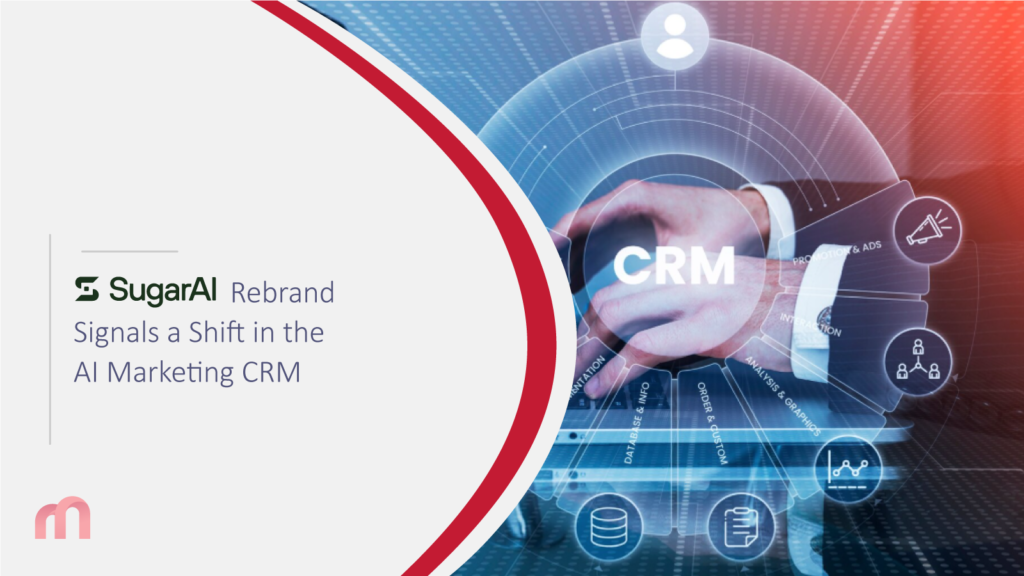
SugarCRM has officially rebranded as SugarAI, signaling a strategic shift toward AI-driven CRM designed to help marketing and revenue teams identify signals earlier, prioritize opportunities, and act with greater precision.
From Campaign Systems to Decisioning Infrastructure
Until fairly recently, most of the developments within the MarTech ecosystem revolved around execution. Systems such as Salesforce, HubSpot, and Adobe were very good at helping organizations scale their efforts.
Faster campaign deployment, automated journeys, and cross-channel tracking have become commonplace in the modern marketing world.
However, decision-making processes have remained mostly manual and reactive in nature.
While there is nothing wrong with relying on static segmentation models or scoring, such approaches tend to be inherently limited due to their reliance on historical data rather than customer behavior changes. That makes any response slow by default.
It is the vision that SugarAI is pursuing with their rebranded solution. Instead of focusing solely on CRM, the company aims to create a platform that will be positioned as a decisioning layer capable of evaluating customer signals in a continuous manner and bringing forward relevant insights.
Talk to our experts to identify where AI can improve your marketing and revenue outcomes.
A Shifting Paradigm in Customer Intelligence
Customer Intelligence has been the cornerstone of modern marketing since its inception. However, traditional solutions to this challenge involved periodic analysis of customer behavior. Weekly reports, monthly dashboards, quarterly reviews.
What we are witnessing right now is the move towards continuous intelligence solutions – where signals from customer behavior are consumed in near real-time, and the model adapts and evolves based on the constantly updated view of the customer.
This is especially true for B2B scenarios, where decision-making requires collaboration across multiple people and follows a longer and nonlinear journey.
Unlike segmentations, these systems can detect changes in the level of engagement, notice changes in buying patterns, and deliver signals about either a potential threat or an opportunity.
According to Forrester, this trend leads to the emergence of revenue platforms that enable integration between data and engagement for marketing, sales, and customer success operations.
Precision Marketing: A More Practical Perspective
While the industry tends to call the above-mentioned trend ‘precision selling,’ it can equally be applied to marketing. In fact, it tackles one of the toughest problems for marketers in MarTech: knowing where and when to focus.
For marketing professionals working in account-based scenarios, there is no lack of activity. There is a lack of visibility and clarity.
Who are the real prospects? What signals show positive momentum? What customer actions should trigger follow-up steps?
These questions are addressed by the integration of AI-powered CRM solutions, which leverage both predictive modeling and behavioral analytics.
Instead of making decisions based on outdated assumptions about customer behaviors, such solutions enable more precise segmentation by tracking customer engagement in real-time and responding to their actions at an appropriate moment.
This approach is certainly not novel, as consumer-oriented applications such as Netflix and Amazon have long been using this strategy. However, while consumer-facing platforms were utilizing advanced technologies for recommendation purposes, enterprise marketing departments were traditionally employing a different approach.
Why Are We Seeing a Surge in These Technologies Now?
One should note that AI-related technologies are not driving this shift on their own. There has been significant growth in terms of technology infrastructure that can support AI models and make them scalable.
Data management practices have also evolved, which enables organizations to integrate their data environment and develop a holistic picture of consumer behavior.
According to Gartner, enterprises are embedding AI technologies within sales and marketing processes to inform decision-making instead of relying on AI-powered analytics alone. In addition to infrastructure improvements, there are changes in consumer expectations.
Assess your current MarTech stack.
Find out if your systems are built for real-time decisioning.
Insights to Orchestration
Insights are valuable in their own right – but by nature, they are incomplete. They inform you about what is going on and what might happen.
The real challenge that most companies face today is what should be done with all this information.
Enter orchestration – connecting signals to actions and actions to outcomes. Ensuring that the marketing, sales, and customer success teams aren’t operating on their own but rather working off the same playbook when it comes to interacting with customers.
SugarAI is one of the players that is positioning itself at this layer of the ecosystem – providing not just relevant insights, but helping companies take action.
Implications for Marketing Leaders
This evolution poses some interesting challenges for marketing leaders who often think about technologies in terms of features rather than capabilities and outcomes.
What really matters is how effective marketing tools and technologies are at making decision-making processes faster and more informed.
Can your platforms recognize important signals early? Is it able to adjust its strategies to new customer realities? Can it help prioritize accounts based on their revenue potential?
These are the capabilities that will define the next generation of marketing systems.
Ready to move from insights to action?
See how AI-driven CRM enables real-time decisioning across your revenue teams.
Reinventing CRM with Pragmatic AI
At the core of SugarAI’s repositioning is a more practical reframing of CRM’s role in modern revenue systems.
For decades, CRM has operated as a system of record, capturing interactions and offering retrospective visibility. In today’s environment, that model falls short. What teams increasingly need is not more data, but systems that can interpret signals and guide action in real time.
As David Roberts, CEO of SugarAI notes, “CRM must do more than store information; it must help teams take the right action at the right time with proactive, guided execution.”
This is where the concept of pragmatic AI becomes relevant, not as an experimental layer, but as an embedded capability that connects CRM with ERP and other operational systems to surface meaningful signals.
According to Cameron Marsh of Nucleus Research, “The bringing together of ERP and CRM bridges the gap between customer-facing front-office operations and internal back-office business transactions.”
The approach is gaining traction in complex, relationship-driven environments, including organizations like Mid-America Parts Distributor Inc., where signal interpretation directly influences revenue outcomes.
The company’s positioning is increasingly aligned with how analysts are redefining the CRM category. SugarAI’s recognition as a Leader by Nucleus Research and its inclusion in Constellation Research’s Revenue Intelligence ShortList highlight growing validation for platforms that connect data, signals, and execution across revenue teams.
Taken together, this reflects a broader shift. CRM is no longer being evaluated by how well it stores data, but by how effectively it translates signals into decisions at the moment they matter.
Closing Thoughts: CRM As A Revenue Intelligence Layer
The decision to rebrand as SugarAI is part of a larger trend that has been developing for quite some time. The modern CRM is evolving from being a repository of customer information into being an engine for understanding priorities, making decisions, and taking action.
Marketing must follow this path as well, transitioning from execution to intelligence, and then to orchestration.
The winners in this transformation process will be those who turn insight into results consistently rather than those who generate the greatest insight. This is what’s really changing, and this will define marketing in the future.
FAQs
1. So how would an AI-driven marketing CRM actually change things for marketing teams?
An AI-driven marketing CRM is different from others since it will move CRM from measuring marketing activities to helping teams make decisions about their accounts and priorities, based on customer actions.
2. Why can’t the current marketing automation solutions be used by marketing teams any longer?
Marketing automation platforms are good at execution rather than decision-making. Most of them can automate marketing campaigns effectively, but lack the capability for signal integration and recommendations.
3. How can AI support ABM strategies of marketers?
Through providing relevant insights into the accounts’ purchase intent and detecting new engagement patterns. AI will also allow for better timing and personalization when it comes to buyers.
4. What should marketing teams expect from the AI-enabled CRM system?
They shouldn’t think that such CRMs will simply do what the regular ones can – generate insights and automate workflows. Instead, they should consider their ability to make decisions.
5. How would an AI-driven CRM align marketing, sales, and customer success teams?
As a shared intelligence layer between all of the departments, such a CRM would bring uniformity of decision-making and actions for different stakeholders.
Discover the trends shaping tomorrow’s marketing – join the leaders at MarTech Insights today.
For media inquiries, you can write to our MarTech Newsroom at news@intentamplify.com