
Marketing technology has stopped behaving like a support function. The MarTech stack now operates more like shared infrastructure, closer to finance systems than to advertising channels.
You can see the shift inside leadership meetings. The CMO reports uneven pipeline coverage even as campaign volume rises. The CRO sees deals stretching out but cannot pinpoint where momentum fades. Dashboards look fine. Activity is higher, engagement exists, and revenue still moves unpredictably.
Replace the automation platform. Add intent data. Consolidate vendors. Hire an agency. Introduce AI to increase output. Each decision makes sense on its own. Together, they rarely stabilize performance.
Gartner’s marketing technology survey found organizations still use only about 42% of the capability already available in their stacks. The number barely changes year to year despite steady expansion in tooling. This is not a training issue, nor is it a missing feature set. It suggests a structural mismatch.
A tool executes an action. A platform organizes activity. A solution produces an outcome. A service sustains that outcome over time. When companies misidentify which one they actually need, Martech performs exactly as designed and still disappoints the business.
That is why the MarTech stack keeps expanding while confidence in marketing performance quietly declines.
Why Martech Stacks Produce Activity Instead of Revenue
Over the last decade, marketing moved closer to revenue. Boards now expect pipeline forecasts, not campaign reports. At the same time, buying behavior is fragmented.
Buyers self-educate across multiple channels long before speaking to sales. That shift has created a logical response. More tracking. More automation. More data systems. Technology has expanded faster than operational clarity.
Teams began solving strategic problems through tactical procurement. A pipeline problem triggered a lead enrichment purchase. Poor conversion triggered email automation expansion. Attribution confusion triggered analytics tooling. Each purchase was reasonable. Collectively, they produced a stack without an operating theory.
This is where the four layers matter.
The Tool: Execution Power
A tool performs a defined task. Nothing more. Nothing less.
Email campaign builders. SEO audit software. Social scheduling platforms. Webinar hosting tools. Dashboarding interfaces.
A tool answers a single operational question. Can we execute this action?
It does not answer whether the action is correct.
Marketing leaders often underestimate the implications. A/B testing software does not improve conversion rate. It allows experiments. The improvement depends entirely on the quality. An outreach automation system does not improve the pipeline. It increases volume. Whether that volume creates trust or fatigue depends on targeting logic and messaging relevance.
In practical terms, a tool multiplies existing competence. If the underlying strategy is flawed, tools amplify inefficiency.
McKinsey’s 2024 B2B Pulse research noted that buyers increasingly disengage from vendors who show early-stage outreach before demonstrating contextual understanding of their business needs. Automation tools make that mistake scalable. What appears to be a productivity investment becomes a reputational risk.
Organizations rarely fail because tools malfunction. They fail because tools are asked to carry strategic weight.
The Platform: Operational Infrastructure
A platform is different. Not a larger tool. A coordination environment.
CRM systems, customer data platforms, and marketing automation ecosystems fall into this layer. They manage identities, permissions, workflows, and relationships between actions.
A platform answers a deeper question. Where does commercial activity live, and how does it connect?
Consider pipeline management. A CRM does not create opportunities. It structures how opportunities are recorded, routed, and governed. If the deal qualification criteria are inconsistent across teams, a CRM faithfully documents the inconsistency. The system performs correctly while the business outcome deteriorates.
This is why platform implementations often disappoint leadership teams. The technology works. Adoption lags. Forecast accuracy remains unstable.
The issue is architectural. Platforms require process design, data governance, and operational accountability. Without that, the platform becomes an expensive shared database updated just before leadership reviews.
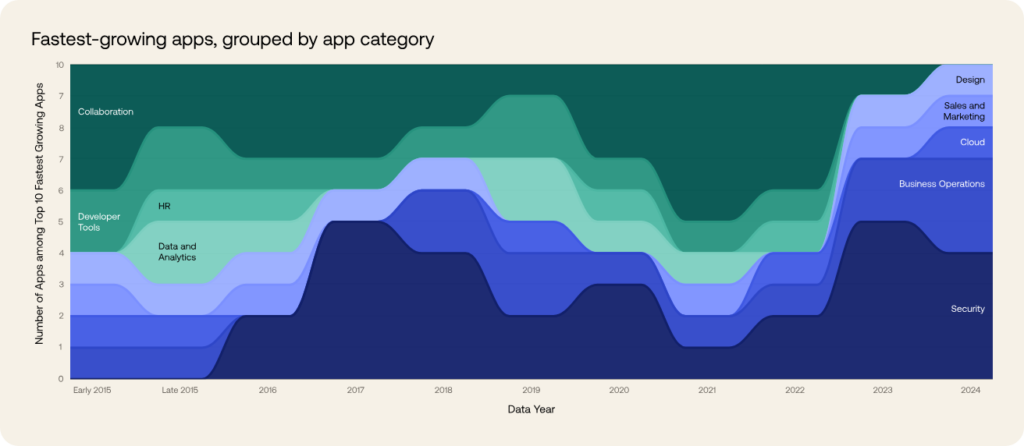
From a security standpoint, the implications are serious. The average enterprise now uses over 100 SaaS applications across departments, according to Okta’s 2025 Businesses at Work report. Many integrate directly into marketing automation or CRM systems.
Platforms enable coordination. They do not create performance.
The Solution: Defined Business Outcome
A solution is where organizations first move from technology to revenue. It is a configured operating mechanism designed to remove a measurable business problem.
Examples include lifecycle nurture programs, account-based marketing orchestration, or intent-driven pipeline acceleration workflows. Notice the distinction. We are no longer discussing features. We are discussing outcomes.
A lead scoring model by itself is not a solution. Improving opportunity win rate through coordinated qualification, routing, and follow-up is.
This is also where many Martech investments quietly stall. Implementation teams configure platform capabilities without defining operational success criteria. Marketing automation workflows launch. Campaigns execute. But no one owns the commercial metric.
According to Salesforce’s 2024 State of Marketing report, high-performing marketing organizations are significantly more likely to share revenue KPIs with sales leadership and align around common definitions of qualified pipeline. The differentiator is not technology maturity. It is outcome alignment.
Solutions require cross-functional agreement. They depend on shared definitions of qualification, timing, and handoff accountability. Without those, platforms generate data while revenue remains unpredictable.
The Service: Continuous Interpretation
The final layer is the least discussed and often the most important. Service.
Markets change continuously. Messaging decays. ICP definitions drift. Channels saturate. Data degrades. Even well-designed solutions deteriorate over time because buyer behavior evolves faster than system configuration.
A service exists to maintain relevance.
This includes managed campaign operations, SEO strategy execution, data analysis, and ongoing experimentation frameworks. The service layer answers a critical question leadership teams eventually confront. Who owns the result after implementation?
Technology cannot observe market context. A platform will continue nurturing accounts even if the messaging no longer reflects industry conditions. A dashboard will display declining engagement without diagnosing why.
HubSpot’s 2026 marketing performance data shows that content engagement rates vary widely by industry but consistently decline when messaging fails to match the buyer research stage. The software tracked behavior accurately. Interpretation requires human analysis.
“Today, more content is generated by AI than by humans. But it’s mostly average. Consumers seek human-created content, and will tune out brand and AI-generated content. Content will move to gated spaces that AI hasn’t overrun, like newsletters, podcasts, and YouTube. Learning to craft content is a timeless skill. Don’t follow the masses and outsource that to AI,” shared Kieran Flanagan, SVP of Marketing, AI, & GTM at HubSpot.
Services introduce operational intelligence. They convert system output into decisions. Without this layer, organizations maintain sophisticated stacks that operate mechanically but not strategically.
Services reduce internal dependency risk but introduce vendor reliance. Mature organizations address this by pairing internal ownership with external specialization rather than outsourcing entirely.
Why Leadership Conversations Break Down
Marketing managers need execution capacity. They evaluate tools. Procurement evaluates contracts, often seeing all four as software purchases.
The result is predictable. A strategic problem triggers a tactical acquisition. For example, declining opportunity quality leads to a data enrichment tool purchase. The issue might actually be segmentation logic and qualification criteria. The tool improves records but does not target.
This mismatch explains why Martech stacks grow while revenue impact plateaus.
Organizations often attempt consolidation as a corrective action. Sometimes it helps. Sometimes it removes useful capabilities while leaving operational ambiguity intact. Technology rationalization cannot replace operational clarity.
The Operational Model That Actually Works
Operationalizing Martech requires mapping each layer to a business responsibility. Tools enable actions. Platforms coordinate processes. Solutions create measurable outcomes. Services sustain performance over time.
Effective organizations design backward from revenue metrics. They define the commercial problem first, pipeline coverage, conversion efficiency, and deal velocity, then determine which layer must change.
If conversion rates fluctuate due to inconsistent qualification, the need is a solution redesign. If data cannot connect across channels, the need is platform governance. If campaigns cannot execute at the required volume, tools matter. If performance degrades despite a correct setup, services become essential.
This sequencing matters. Otherwise, teams invest in capacity before clarity.
One more uncomfortable point. Artificial intelligence does not remove these layers. It intensifies them. AI increases execution speed, which amplifies both effective and ineffective operating models. Companies with defined solutions benefit. Others automate confusion.
Implication for Organizations
Martech has matured beyond a collection of applications. It now functions as commercial infrastructure, closer to finance systems than advertising channels. That shift requires leadership to evaluate it differently.
The question is no longer what software to buy. The real question is which responsibility the organization is trying to assign.
When a company purchases a tool expecting a solution, it gains activity without improvement. When it deploys a platform without governance, it gains data without insight. When it designs a solution without ongoing service, it gains temporary results.
Operationalizing Martech means aligning technology layers with business ownership. Once that alignment exists, software starts behaving less like an expense and more like a predictable revenue mechanism.
Until then, organizations will continue to expand stacks, hold quarterly performance reviews, and wonder why the systems keep working while outcomes do not.
FAQs
1. Why does a Martech stack increase activity but not revenue?
Most stacks optimize execution rather than operating logic. Tools automate campaigns and platforms record interactions, but revenue depends on qualification criteria, handoff ownership, and commercial processes. When those are undefined, the system produces engagement data without improving deal outcomes.
2. What is the difference between a Martech tool, platform, solution, and service?
A tool executes a task, such as sending emails or running campaigns. A platform coordinates processes and data, such as a CRM or marketing automation system. A solution is a configured workflow tied to a measurable business outcome, like improving win rate or pipeline quality. A service continuously interprets performance and adjusts the system as markets and buyer behavior change.
3. Why do CRM or marketing automation implementations often fail to improve pipeline predictability?
The technology reflects existing processes. If qualification standards, routing rules, and ownership are inconsistent, the platform records those inconsistencies accurately. The system works technically, but forecast reliability does not improve because the operating model is unclear.
4. How does AI affect Martech performance?
AI accelerates execution speed. It can generate content, automate outreach, and analyze data faster, but it does not define targeting logic or commercial strategy. In organizations with clear operating models, AI improves productivity. In unclear environments, it scales ineffective activity and amplifies poor results.
5. Why do marketing and sales leaders disagree about pipeline quality?
They measure different stages of the same process. Marketing evaluates engagement and lead volume, while sales evaluates deal readiness and conversion. Without shared definitions of qualification and ownership, both teams can appear correct while revenue performance remains unstable.
Discover the trends shaping tomorrow’s marketing – join us at MarTech Insights today.
For media inquiries, you can write to our MarTech Newsroom at info@intentamplify.com.