Imagine a shopper scrolls through Instagram on her coffee break. She spots an appealing autumn sweater advertisement from a brand she doesn’t even remember. A single click, and she’s on the store’s site. A half-hour later, she’s added two sweaters to her cart but closes the browser window just short of check-out. But was that truly the final step? If you’re an advanced marketer, you already get it that “near-purchase” was only the beginning. In this fast-paced, competitive retail environment, every minute detail of interaction counts, and it is here that Marketing Technology (MarTech) enters the scene as the quiet enabler behind the scenes. From that first click to the final “Place Order” and often even thereafter, it is MarTech that ignites the buyer’s journey.
But the point is: customers don’t have funnels or automations. They have experience. And so MarTech must do more than observe behavior; it must drive it.
In this article, we’ll explore how MarTech optimizes each stage of the retail buyer journey, not in theory, but in measurable, trackable, revenue-driving practice. We’ll break it down across the key phases of awareness, consideration, decision, and loyalty with real examples, recent trends, and a healthy dose of retail reality.
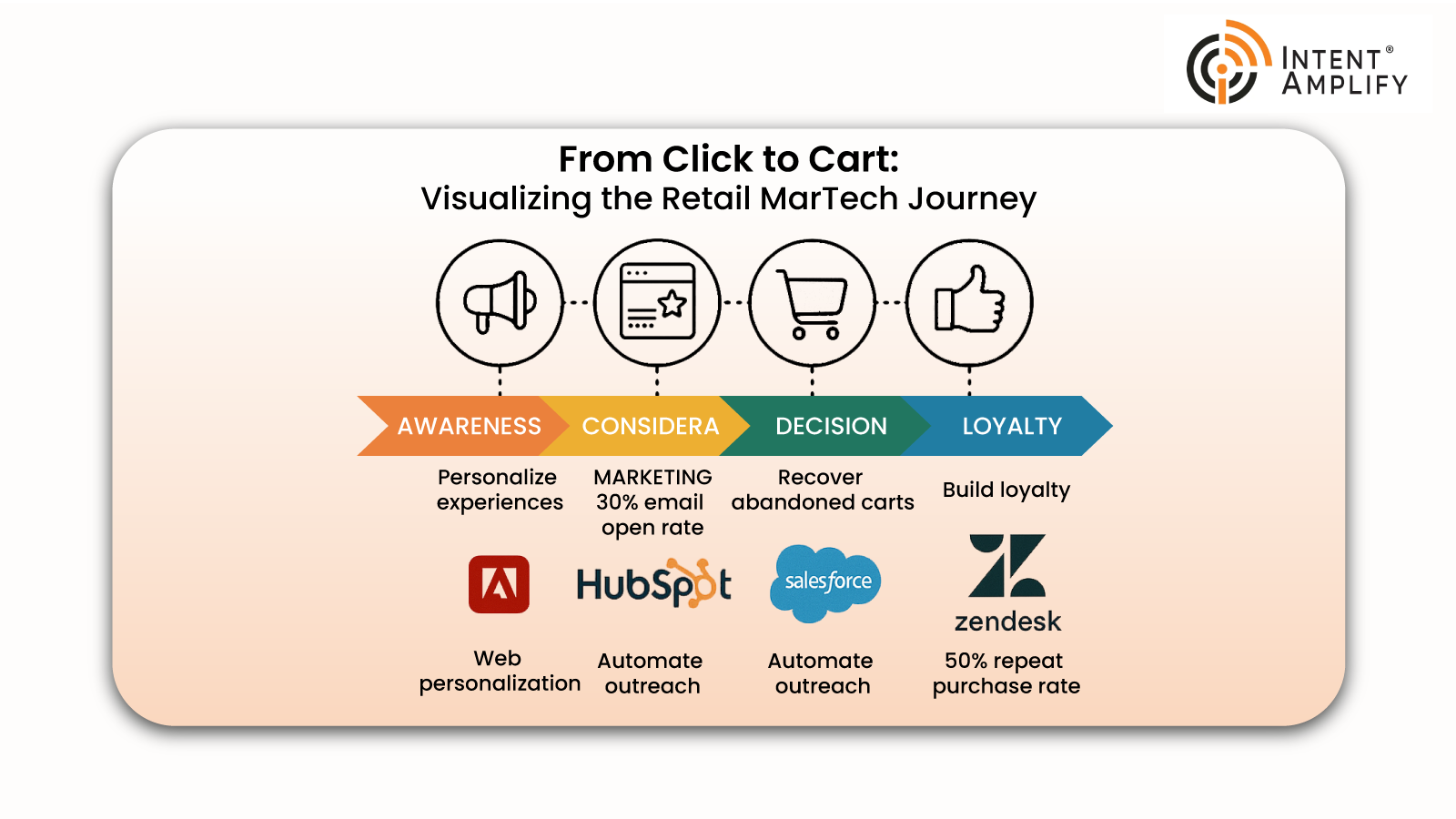
1. Awareness in Retail: From First Glance to Digital Footprint
Did you know this tidbit? The average consumer sees over 5,000 advertisements each day – Forbes. But among the many, only a flicker survives the drift of time. So,o how do we ensure that our message gets through?
Enter MarTech. MarTech platforms like Adobe Experience Cloud and Salesforce Marketing Cloud use AI and data aggregation to figure out what’s working and with whom. HCL Unica and SAP Emarsys are just a few of the technologies that allow retailers to analyze social activity, website behavior, and even third-party data to drive laser-focused awareness campaigns.
Example:
Imagine launching a summer sandal line. Instead of bombarding every subscriber with the same offer, AI-powered segmentation has your California sun worshipers getting beachwear deals, while New York City consumers get city-style variations.
Retail MarTech is not just serving up content. It picks up on intent signals, fine-tunes the moment, and delivers tailored messaging to the exact audience profile. Call it intent-based storytelling.
As McKinsey states, those that are utilizing customer behavior data are growing sales at 85% higher than their peers.
2. Consideration: Leading the Curious Without the Pushy Pitch
Let’s discuss this point of pause. The consumer has clicked. Perhaps browsed. But hasn’t converted.
This is where the MarTech solutions, such as HubSpot, Oracle Marketing Cloud, and Klaviyo, excel. These solutions assist with automating email workflows, displaying dynamic product recommendations, and measuring product page dwell time, all without feeling too salesy.
You look at a blender on a site, then get an opportunistic email: “Still thinking about smoothies?” It includes a product comparison grid, a short testimonial, and a single-use discount. The pressure is off. Just value that counts.
What’s Working Now
Behavior-based automation: If a customer views 3+ product pages without buying, send a “Need help deciding?” message.
Content commerce: Embedding shoppable videos or guides directly onto the site via tools like Shopify’s native MarTech integrations.
Retailers are not just selling, they’re teaching. With MarTech, every click is a breadcrumb that leads buyers nearer to a purchase decision.
3. Decision: Cart Conversion Is a Team Sport
Fact: Over 70% of online carts are abandoned according to Baymard Institute. It’s hard to ignore the big truth hiding in plain sight. Nearly 70 out of every 100 online shopping carts are left behind. But lost doesn’t need to be so if your MarTech stack has ears.
Platforms such as Salesforce Commerce Cloud, Zendesk, and Genesys streamline online shopping by enabling smooth payments, instant customer support, and intelligent retargeting paths that help turn casual visitors into paying customers.
Smart Example:
A customer adds products to a cart but does not buy. One hour later, they get an automatically triggered chatbot message on WhatsApp (powered by Genesys):
“Looks like you left these behind – Check out now and get free shipping!”
Not spam, clever retargeting. And it works. According to a source, abandoned cart remarketing emails recover 10-30% of carts.
What Else Works in Retail?
Mobile-optimized UX: Cart drop-offs occur most frequently on mobile. MarTech solutions identify device friction and suggest design updates.
Live A/B experiments: Conducted via Unica and Oracle Marketing Cloud, help reshape customer click behavior and reduce checkout friction.
4. Loyalty: One-Time Buyers Now Become Lifetime Advocates In Retail
Here’s the truth: The buyer journey doesn’t end at checkout; it starts all over again.
That’s where MarTech for building loyalty comes in. MarTech like HubSpot, Zendesk, and Emarsys allows brands to automate review requests, loyalty rewards, re-engagement emails with a personal touch, and post-purchase surveys.
Why It Matters In Retail
It costs 5 – 7 times more to bring on a new customer compared to keeping an existing one, according to Harvard Business Review.
With MarTech:
- Recommender engines recommend relevant add-ons.
- Loyalty dashboards indicate when to reward the best buyers.
- Email nurturing streams shift based on Customer Satisfaction Ratings (CSAT).
Real-World Cue:
A customer pens a rave review. Your system flags them as an “advocate” and automatically places them on a VIP early-access list. When your latest drop drops, guess who’s standing in line?
5. Analytics For Retail: The Invisible Backbone of the Buyer Journey
No MarTech strategy is set without robust analytics. Every click, view, bounce, and conversion is a datapoint, fueling smarter campaigns in the future.
Tools like Google Analytics 4, Mixpanel, and Looker track everything from acquisition channels to post-purchase behavior. Retail marketers get immediate visibility into MarTech dashboards, not vanity metrics, but actionable insights.
Retail Pro Tip:
The greatest MarTech stacks blend measurement with tools for doing. Imagine this: launching an ad campaign only when site traffic drops below average. Or increasing SMS frequency only when email open rates drop.
Recommended: Best MarTech Tools for Online Retail Businesses
Conclusion: The Retail Future Is Automated, But Never Robotic
In an age where consumer behavior shifts with each swipe and scroll, MarTech enables brands to not only keep up, they outrun. From awareness to loyalty, every touch is now an opportunity, fueled by tools that are smarter, wiser, and capable of doing more.
So the next time a cart is left behind or a shopper procrastinates on a product page, keep in mind MarTech isn’t silently observing. It’s functioning actively.
Key Takeaways:
MarTech allows retailers to individualize, automate, and scale every step of the customer journey.
Adobe, Salesforce, HubSpot, and Zendesk are a few of the tools that have distinct yet interdependent roles.
It’s not a matter of “selling” more; it’s about building smarter, frictionless experiences that earn trust and drive conversions.
FAQs
1. What is the role of MarTech in retail marketing?
MarTech solutions support retailers with automating campaigns, personalizing experiences, and tracking behavior by channel, simplifying the buying process and making it customer-centric.
2. What MarTech tools work best for small-to-medium retailers?
Platforms like HubSpot, Klaviyo, and Shopify integrations are simple to implement and affordable for growing retailers who must grow customer interaction.
3. How does MarTech reduce cart abandonment rates?
MarTech solutions send automatic reminders through email, live chat support, and customized offers when the cart is abandoned, increasing conversion rates.
4. Is MarTech specific to online retail?
Far from it. MarTech is being used by numerous brick-and-mortar merchants for loyalty programs, in-store activity tracking, customized SMS, and omnichannel campaigns combined.
5. How can I compute MarTech ROI in retail?
Track the metrics, including conversion, average order value, customer lifetime value, and retention. Many platforms also offer built-in dashboards to monitor ROI.
Discover the trends shaping tomorrow’s marketing – join the leaders at MarTech Insights today.
For media inquiries, you can write to our MarTech Newsroom at news@intentamplify.com