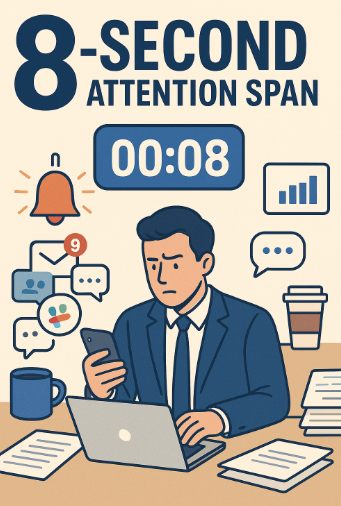
Think of it this way: A professional, who is full of work, manages his emails, Slack notifications, and takes a coffee break. During that very short time, a brand has about eight seconds or less to grab attention. Research indicates that the average human attention span is around eight seconds.
The question that marketers and MarTech professionals face is this: how do you get the consumer’s attention when they are always distracted? This article explains why attention is still the most important thing and how brands can get it by using micro-moments, personalization, and clever MarTech strategies.
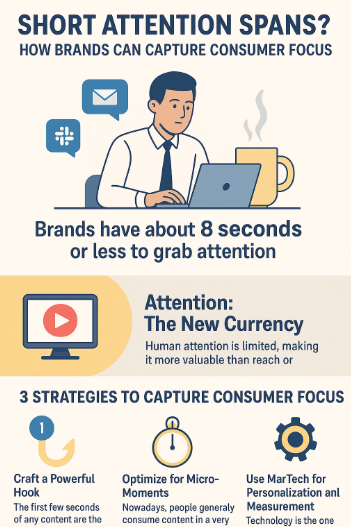
Attention: The New Currency
In the world of attention economy, human concentration is limited, which makes it even more valuable than reach or impressions. The research proves that a 10% increase in attention can result in a 17% increase in spending. According to McKinsey’s 2024 ‘Attention Equation’ research, brands must shift from measuring just time spent to measuring valuable time – i.e., attention that includes focus and intent.
To put it simply, a brand can have a great influence on a consumer if it gains his/her attention. However, if the consumer’s attention is not there, even the best creative or offer will not make an impact. Dentsu’s 2024 Attention Economy report found that a viewable ad impression often isn’t truly viewed – underscoring the gap between exposure and meaningful attention.
Strategies to Capture Consumer Focus
1. Craft a Powerful Hook
The first few seconds of any content are the most important ones. A great hook may be:
- Bold openings: “Here’s what nobody ever tells you about…”
- Relevant messaging: Make the message fit the audience. “IT leaders: this is for you.”
- Immediate value: Give a clear benefit in a few seconds. Example: “In 10 seconds, discovering the MarTech tool that makes Workfig more efficient.”
A compelling hook is basically a guarantee against the massive volume of content produced daily that your message won’t be missed.
2. Optimize for Micro-Moments
Nowadays, people generally consume content in a very short time and mostly by using mobile devices. So how can a brand satisfy this consumer behavior:
- The use of short-form content: The most popular mode of engagement online is through short videos and visuals.
- Social media tailored tactic: LinkedIn is more preferable for longer posts that are skimmable; however, TikTok is more suitable for quick visuals and hooks.
- Meet immediate needs: Delivering “Which MarTech tool can quickly solve X problem?” instantly fulfills the user’s need.
Creating a mobile-friendly site: Minimalistic visuals, large characters, and rapidly loading pages serve the limited attention span of the user.
3. Use MarTech for Personalization and Measurement
Technology is the one that can keep a brand’s consumer attention not only at the very first glance but also next time:
- Personalized content: Collect data to make the content more relevant and interesting to each user segment.
- Attention measurement: Observe focus by tracking dwell time, video completions, and scroll depth.
- Update swiftly: By using fast work cycles, Pluggable hooks, visuals, and formats to find out what makes attention last. Resources like HubSpot, Adobe, Salesforce, SAP Emarsys, HCL Unica, and Zendesk provide this more conveniently.
By combining analytics and creative strategy, brands can successfully engage consumers within those short moments of attention. An academic 2024 study proposes a model of ‘attentional agency’ – the idea that attention is not just captured but voluntarily allocated, which means brands need to earn it rather than demand it.
Real-World Example
A 10-second video is used by a B2B security brand that starts with the lines: “3 seconds: a breach could cost you. Here’s the fastest fix.” The micro-format of this video immediately draws attention, and then it goes for a short demo; thus, the brand is turning a brief view of the video into a valuable interaction. Likewise, the personalized micro-messages that are sent through MarTech platforms can attract the prospects because they are highly relevant, thus, the attention and conversion metrics get improved.
Conclusion
In a world where the attention span is getting smaller, the brands that will survive are those that focus on the quality of attention, use micro-moments, and MarTech to personalize and measure. The main point is to create hooks that bring instant value, work for mobile-first consumption, and measure attention for engagement optimization.
Key Takeaways:
- Attention is more valuable than just reach.
- Micro-moments and device-optimized content are the main engagement drivers.
The implementation of MarTech enables the personalization and measurement of brief interactions, turning them into meaningful communication.
FAQs
Q1: What counts as “attention” in marketing?
It is an active engagement, e.g., scroll depth, video completion, dwell time, or micro-interactions.
Q2: Is the “8-second attention span” reliable?
It’s an average that is derived from multiple studies; the main point is to realize that attention windows are short and have to be taken into consideration.
Q3: How can MarTech help to capture attention?
By personalizing content, setting attention metrics, and optimally running campaigns in real-time.
Q4: Should all content be short-form?
Definitely not. Short-form is for grabbing attention; however, long-form works when relevance and value are already there.
Q5: How do I test attention effectiveness?
By setting KPIs such as video completion, scroll depth, dwell time, and A/B test hooks, formats, and visuals for ongoing progress.
Discover the trends shaping tomorrow’s marketing – join the leaders at MarTech Insights today.
For media inquiries, you can write to our MarTech Newsroom at news@intentamplify.com