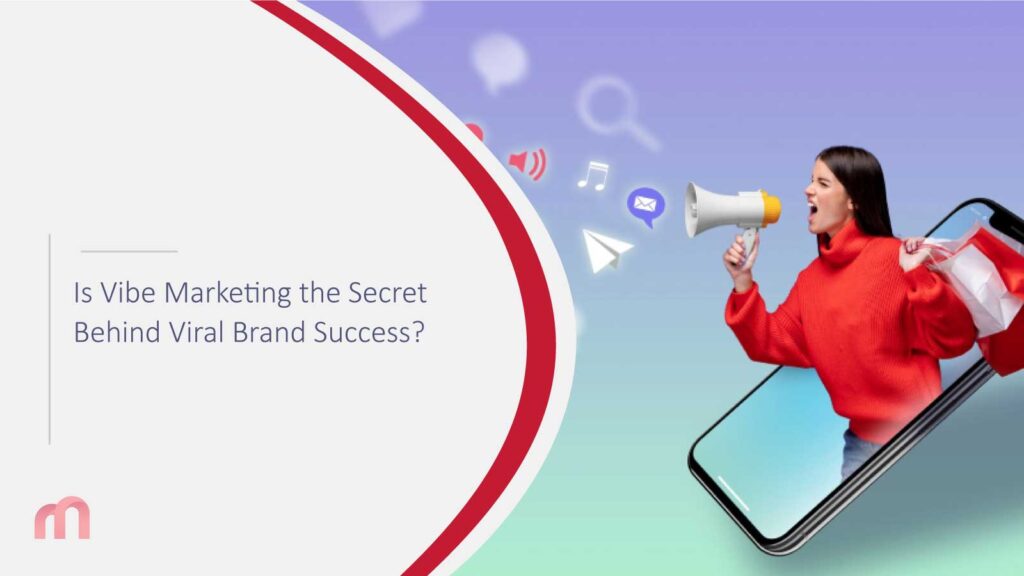
Some companies are so good that they don’t even need to explain themselves. They just get in touch.
You come across an ad, look away after a second or two, and smile. You move on, but later you remember the brand. It is not a matter of luck. That is vibe marketing in action.
In today’s marketing technology environment, characterized by a decrease in attention spans and an increase in content volume, brands no longer win by being louder. They do so by being more appropriate.
Therefore, is vibe marketing the only reason that explains brand success going viral?
In most cases, vibe marketing is accompanied by discipline, data, and an unshakable purpose.
What is Vibe Marketing?
Vibe marketing is about the emotional feel of the brand, which the brand delivers to the customers through every digital touchpoint.
It is not only what the brand talks about. It is the brand’s appeal, its image, and its character.
The objective is very straightforward:
Generate a consistent emotional signal that people can recognize immediately.
The sign may show trust, confidence, serenity, humor, or that someone belongs to a certain community. If it is carried out successfully, it becomes familiar within a community, and engagement is led by that familiarity.
This is important, as people understand their feelings quicker than their logic. The research done by Harvard Business School proves that even in professional environments, emotional responses have a strong impact on decision-making.
Why Does Vibe Marketing Work So Well Now?
Today, audiences do not linger. They are always on the move.
Data shows that users worldwide are on social networks for more than 2.5 hours a day, and during that time, they are constantly making decisions in a split second regarding what to choose for their next engagement. Research shows companies that excel at personalization- an essential component of successful vibe marketing- generate about 40% more revenue than those that lag.
Vibe marketing is in total agreement with such conduct because:
-
- Emotion is much quicker than information
-
- Authenticity leads to higher engagement levels
-
- Consistency makes recall and trust easier
The Edelman Trust Barometer indicates that 81% of consumers claim that trust is what mainly influences their choice of brands. A well-defined brand’s steady vibe is a great supporter of trust on a large scale.
The Role of Marketing Technology
Vibe marketing is one of the most creative things that marketers can do, but it is also a very measurable concept.
Today’s MarTech platforms are very helpful for brands to shape and refine their emotional signals by using data. Gartner reports that customers engaged through active personalization are 2.3× more likely to confidently complete critical purchase decisions, a clear sign that personalized vibe strategies matter in buyer journeys.
As brands scale these capabilities, many are also adopting vibe coding, embedding brand tone directly into AI models, personalization logic, and automation workflows to maintain emotional consistency across digital experiences.
Some of the key contributors are:
-
- To recognize the reactions of the people to the use of a certain tone and language, AI-driven sentiment analysis is used.
-
- Personalization engines make communication more personal without destroying the brand identity.
-
- Social listening tools help monitor the emotional cues that are given by the customer in real time.
According to Salesforce research, 73% of customers demand that companies understand their needs individually. Via technology, vibe marketing enables the fulfillment of such a demand without being a typical mechanical one.
Brands That Get the Vibe Right
The good vibe marketing is visible by the power of the examples across different sectors.
Nike does not communicate products, but belief and movement.
Notion expresses clarity and calm through its visual identity and communication.
Duolingo applies humor and personality to become familiar with a large number of people quickly.
Various industries. Different audiences. One common factor: emotional consistency.
These companies are not trend chasers but brand reinforcers.
A Practical Vibe Marketing Framework
High-performing marketing teams have a systematic way of dealing with vibe marketing.
1. Emotional core definition
Decide how the brand should always make people feel.
2. Tone-tech alignment
Automation and AI must always be in the same voice with the help of technology.
3. Maintenance of team cross-consistency
Being in unison of voices, the marketing, sales, and support departments should sound as one.
4. Quality engagement measurement
Going deeper than simple clicks, one can find more trustworthy signals of resonance.
5. Adaptive identity management
Culture is an ever-changing thing. Brand values should, however, serve as the vibe anchor.
Why Vibe Marketing Matters to Professionals
For professionals who are always on the go and those who have the power to make decisions, understanding things clearly is what really matters.
Vibe marketing:
-
- Facilitates communication
-
- Increases trust quickly
-
- Enhances brand value over time
Bain & Company states that even slight changes in customer retention can have a big effect on the company’s profitability. An emotional bond is the main support for that retention.
Conclusion
Vibe marketing is not a temporary trend.
It reflects the way people interact with brands nowadays.
Marketing tools allow departments to keep up with the demand for emotion in a very authentic way. Those brands that will be successful will not be the ones that are dependent on quantity only. They will invest in quality.
Because in a world full of digital noise, the most powerful brands are not only seen.
They are experienced emotionally.
FAQs
1. Is vibe marketing relevant for B2B brands?
Yes. Decision-makers require the same things as consumers, i.e., clarity, trust, and emotional consistency.
2. How is vibe marketing different from branding?
Branding is the identification of the brand. Vibe marketing is the assurance that the brand identity people experience in the real world.
3. Does vibe marketing replace performance marketing?
No. It supports performance by elevating the quality of engagement and making the message more relevant.
4. Can AI support vibe marketing effectively?
Certainly. AI is a great helper when it comes to the analysis of tone, sentiment, and engagement patterns.
5. How quickly can brands see results?
The first sign of improvement is usually engagement, and it is followed by trust and loyalty, which take time to build.
Discover the trends shaping tomorrow’s marketing – join us at MarTech Insights today.
For media inquiries, you can write to our MarTech Newsroom at info@intentamplify.com.