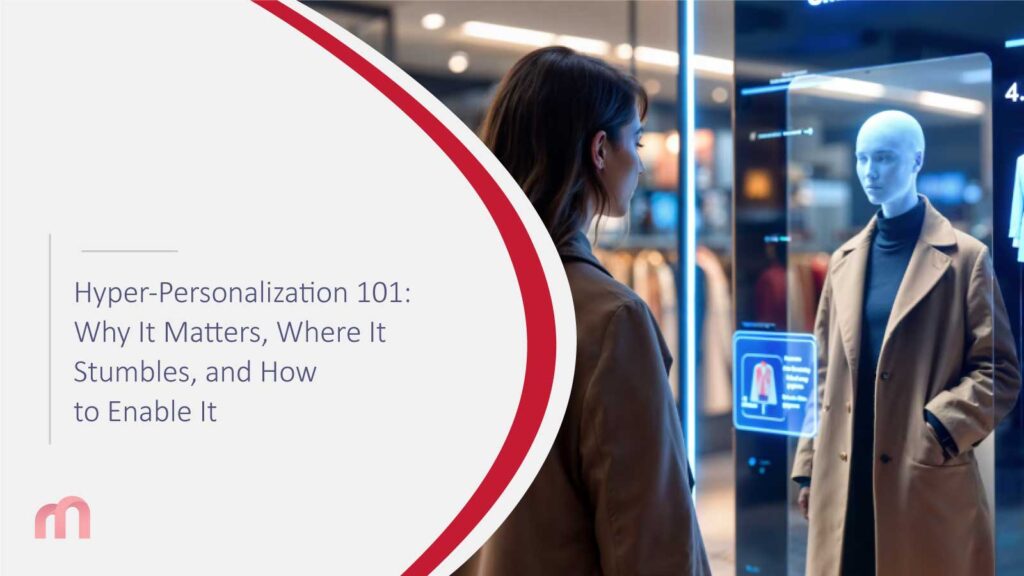
Personalization of marketing previously was merely inserting someone’s first name into an email header. “Hello, Sarah, we think you’d like this.” It used to be magic for a short time. Customers are brighter now, and no longer so easily amazed. Customers now expect brands to not only know their name, but also their mood, inclinations, intent, and even their underlying needs that drive their purchasing process. It is where hyper-personalization comes in. Rather than brushstrokes, it hits with accuracy. By leveraging the power of AI, real-time data, and behavior data, hyper-personalization directs marketing from the one-size-fits-all campaign towards something that is almost unbelievably intelligent.
But here lies the rub: though hyper-personalization promises increased engagement and improved conversions, it also stumbles upon massive hurdles from data inundation and ethical complexities to gaps in implementation that put teams on the path to frustration. So much for the real question not being what hyper-personalization is, as instead: why does it matter, where does it fail, and how do organizations get it to work in the long run?
Let’s break it down into bite-sized pieces.
Why Hyper-Personalization Matters More Than Ever
We are in the era of unlimited choice. Customers can swipe brands away, ad-block in a matter of seconds, and tune out mass messaging without even raising an eyelid. Attention is the most valuable currency to play for. Hyper-personalization is the way businesses win it.
1. Rising Consumer Expectations
71% of McKinsey customers now expect firms that they buy from to customize to them, and 76% become furious when they fail to. When your customer has grown used to tapping into Spotify to provide them with the ultimate playlist or Netflix to tell them what they’re in the mood for next, an off-the-shelf letter or static home page is like a slap in the face.
2. The Psychology of Relevance
Hyper-personalization is really all about a single, pretty human desire: being understood and seen. It’s the “recognition effect” that behavioral psychologists refer to to be recognized increases one’s chances of responding positively. It’s why people feel more positively when offers are made to them and customized to their details it doesn’t just work better statistically; it makes people feel better.
Consider Amazon, for example. It doesn’t simply suggest “books you’d like.” It notices you purchased a beginner photography book in December and thus suggests a tripod. That’s not chance it is behavior data plus relevance.
3. The Business Case
The ROI is no less persuasive. McKinsey studies indicate that leading hyper-personalization businesses have acquisition costs 50% lower, revenues 5–15% greater, and 10–30% greater marketing effectiveness. Plain language: personalization isn’t a “nice to have.” It’s staying alive in a more competitive universe.
Where Hyper-Personalization Falls Short
Irrespective of anything, hyper-personalization always falls short. Brands are so eager to surf the wave that they rush to embrace it and later find themselves against walls they never imagined.
1. Data Overload Without Strategy
Nowadays, businesses have heaps of customer data. The more, the worse. Too much data, unstrategically, is paralyzing. Marketing people never even know what the most significant signals are, or how to eliminate noise from the signal. Outcome? Gobsmacking dashboards with zero effect.
2. Technology Craters and Tool Redundancy
The MarTech stack has gone to the stratosphere with giants such as Salesforce, Adobe, HubSpot, Oracle, and HCL Unica all possessing hyper-personalization. But in the great outdoors, it does not happen quite like that. Tools cannibalize each other’s lunch, integrations do not work, and teams spend time brawling over a half-dozen dashboards rather than running campaigns. Around 71% of CMOs, as Gartner confirms, acknowledge receiving lower ROI on their MarTech spend, typically because they wrote checks first and then wondered. Moreover, many brands underutilize their Martech stacks; Gartner has found that brands use just 58% of their purchased capabilities.
3. The “Creepy Line”
That’s the challenge: personalization is fine until it gets too intrusive. Customers appreciate it when Netflix understands their taste, but they freak out when a commercial records something they complained about a friend within earshot of their phone. In a Harvard Business Review study, it was discovered that when consumers sense that personalization starts to morph into monitoring, trust is lost, and the company incurs long-term reputational costs.
4. Resistance Interna
With technology implemented, execution breaks down if teams are not aligned. Marketing, sales, IT, and data science all exist in their own silos. Personalization plans are earth-bound without integration, and campaigns are “spray and pray” again.
Frameworks for Enabling Hyper-Personalization
So how do you get it to work? It’s not so much slapping AI onto your email application. It’s creating an orderly process that brings data, technology, psychology, and process together.
1. The DATA Framework (Collect, Clean, Connect, Contextualize)
- Collect the appropriate data (behavioral, transactional, contextual).
- Clean it of duplicates and errors.
- Connect it all together across systems to build a single customer view.
- Place it in the context of AI/ML so you’re predicting intent, not segmenting.
2. Human-Centered Design
Hyper-personalization isn’t algorithmic, it’s human-centric. Techniques like Jobs To Be Done (JTBD) enable us to ask: What “job” is the customer attempting to get done in this particular moment? Instead of bathing them in offers, can you give them content, advice, or belief for their moment?
3. Micro-Moments Mapping
Grown out of Google’s “I want to know, go, do, buy” moments, micro-moment mapping helps brands to predict temporary intent. Illustration: A travel customer seeking “best hotels near me tonight” requires a swift, location-sensitive, mobile-targeted recommendation rather than a broad travel brochure.
4. The Feedback Loop
Hyper-personalization is not “set and forget.” Ongoing testing, learning, and optimization are required. A/B testing, sentiment analysis, and real-time analytics are a feedback loop, meaning campaigns adapt based on how consumers are acting.
Recommended: The Ultimate Guide to B2B Personalization: Strategies Marketers Need for 2025
Real-World Examples That Work
Spotify Wrapped: A yearly cultural phenomenon founded on personal listening habits. It doesn’t just report; it enables discussion and social sharing in bulk.
Nike By You: Customizable goods with AI-recommended options. Customers are co-creators, not just buyers.
Starbucks Rewards: Uses purchase history, time of day, and location to deliver contextual offers (“It’s 8 am, your morning latte awaits”).
They’re not tricks. They’re based on behavioral data, empathy, and context.
The Future to Come: Where Hyper-Personalization Is Going
We are only just getting started. The future of hyper-personalization is about less “campaign” thinking and more about continuous, adaptive experiences.
1. Autonomous AI and Agentic Personalization
No more will marketers make all the decisions. Agentic AI systems will dynamically generate, test, and optimize individualized experiences across channels. It’s like personalization that learns and evolves in real-time without human involvement.
2. Ethical Personalization as a Differentiator
Customers will grow privacy-conscious. Businesses that are expecting personalization but also ready for transparency will succeed. Discover “ethical personalization,” where users can view and govern their use of information to become a foundation of distinction.
3. From Digital to Physical Spaces
With edge computing and IoT, even environments will be hyper-personalized. It would mean walking into a shopping mall where web-browsing on your digital devices changes, or a car that auto-tunes its dashboard according to your calendar.
4. Predictive and Preventive Experiences
Tomorrow’s personalization won’t just react; it will anticipate. In healthcare, AI-driven personalization could recommend preventive care before symptoms surface. In retail, it could predict when you’re about to run out of groceries and auto-replenish.
Conclusion: From Hype to Habit
Hyper-personalization is not cool. Hyper-personalization is the natural next step in a set of marketing evolutions in an AI and data world. But with balance only: technology deployment without sacrificing the human touch, data deployment without crossing over to the creep line, and strategy and not cool tools.
The winners of the brand won’t be the spenders and the owners of the tech. They will be the ones who can make customers feel not only targeted, but really understood. Because at its core, hyper-personalization is less about algorithms and more about empathy, at scale.
FAQs
1. How is hyper-personalization different from regular personalization?
Day-to-day personalization employs static data such as name or demographics. Hyper-personalization employs real-time behavior, contextual, and predictive data to provide context at the time.
2. Is hyper-personalization the sole domain of large corporations?
Not at all. Large organizations are at the forefront, but SMEs can implement mini-variations using CRM, email platforms based on AI, and inexpensive analytics packages.
3. How does AI enhance hyper-personalization?
It’s AI-driven. From natural language processing (customer input) to machine learning (predicted suggestions), AI drives the range and accuracy that even a human cannot provide.
4. What is the biggest error business commits?
Blindly rushing into tech investment without a strategy. Tools don’t execute well-defined frameworks and well-stated objectives do.
5. Is hyper-personalization moral?
It can, if brands hear and engage their customers. It is not doing everything; it is doing everything responsibly to build value, not influence.
Discover the trends shaping tomorrow’s marketing – join the leaders at MarTech Insights today.
For media inquiries, you can write to our MarTech Newsroom at news@intentamplify.com