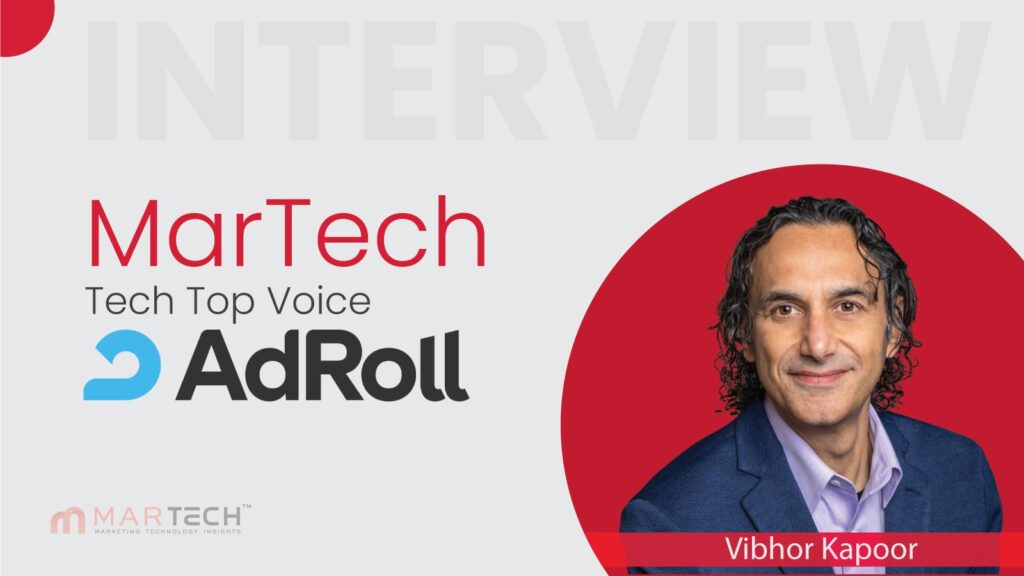
Today’s MarTech Top Voice: AdRoll, Chief Business Officer, Vibhor Kapoor.
For the latest edition of our MarTech Top Voice Interview Series, we sit down with Vibhor Kapoor – Chief Business Officer at AdRoll, a global leader in full-funnel, cross-channel advertising trusted by thousands of ambitious brands. Vibhor’s career spans powerhouse companies including Microsoft, Adobe, and Box, and today he spearheads AdRoll’s mission to build a privacy-forward, AI-driven marketing platform that cuts through fragmentation and drives measurable business impact.
In this high-energy conversation, Sudipto, Global Head of Marketing at Intent Amplify, dives deep with Vibhor to decode what many are calling the next chapter of modern marketing technology. Think of it as the opening frame of a Marvel storyboard — data universes expanding, AI engines accelerating, and the martech landscape shifting beneath our feet.
Together, they explore the forces reshaping the industry — from the explosive proliferation of marketing channels to the rise of AI-native workflows, the new physics of cross-channel attribution, and the evolution of digital commerce in a privacy-first world.
This dialogue delivers rare clarity on:
-
How modern adtech is becoming an intelligent, full-funnel ecosystem
-
Why AI isn’t simply speeding up marketing — it’s rewriting its foundations
-
The shift from experimental martech to accountable, deterministic systems
-
The coming era of AI-driven commerce across short-form content, streaming, and generative engines
-
The skills hybrid Polymath-style MarTech leaders need to thrive
At its core, this conversation is more than an interview — it’s a field guide for marketers navigating rapid transformation, where technology, creativity, and strategy converge. Step into the story and witness insights from one of the industry’s most forward-thinking executives — a conversation that does not just comment on the future of MarTech, but defines it.
MarTech Insights (MTI): Vibhor, you’ve had an impressive career journey—from Microsoft to Adobe to Box, and now leading AdRoll. What’s been the most defining shift you’ve observed in the marketing technology landscape over these years?
Vibhor: It would have to be the proliferation of marketing media and channels. Looking back 15 years and beyond, I had not imagined the shifts we would undergo in terms of the media channels that brands and marketers need to engage with today to convey their message effectively. It has added as much creativity and excitement in marketing as it has added complexity. From web, social media, mobile in-app, connected TV, audio, retail media, digital out-of-home, to emerging formats in generative AI platforms, your options for picking the mix are wide and will only get more complex.
MTI: You’ve led AdRoll through a significant evolution. From an adtech company to a full-stack, privacy-forward marketing platform, you have seen it all. How do you define and lead such a transformation?
Vibhor: In any transformation, you look at the trifecta of the customer, the industry, and yourself. It goes without saying that you need to understand secular trends and industry shifts. And then, concurrently, map the shifts and evolution in the problems your customers and prospects face in light of trends. This is where you need to look at your competitive advantages and what you are uniquely positioned to solve in the industry. This approach has been central for me and the executive leadership team in the transformation we have led at AdRoll.
MTI: AdRoll and AdRoll ABM cater to very different audiences—B2C and B2B. How do you maintain strategic focus and drive growth across both segments simultaneously?
Vibhor: While AdRoll caters to audiences across B2C and B2B, it is important to understand that the problems we are trying to solve and the jobs to be done share many similarities. We want to help ambitious, growth-minded, savvy marketers bring their message to their audience—some in a direct-to-consumer context and others in an account-based context where decision-making is committee-driven. We use similar foundational platform components of multi-channel marketing, integrations across your martech stack, data and AI foundation, and performance reporting and attribution to enable two products that are purpose-built for these segments. The one core and two use cases help us maintain a very tailored user experience, while also scaling and accelerating product innovation.
Recommended MarTech Insights: MarTech Top Voice Interview with Natalia Vasilyeva, EVP Marketing and Strategy at Anzu
MTI: The marketing world is buzzing about AI. From your perspective, how is AI truly transforming marketing operations beyond the hype?
Vibhor: First, by breaking the mold. Marketing workflows, teams and organizational structures have organically evolved over the last several years with every incremental martech innovation. We live in what I describe as a garden where we can’t decipher the weeds from the grass. AI now enables marketing teams to reimagine the work they need to do within an entirely new paradigm.
Second, by increasing velocity and scale. AI-powered workflows let you push the mundane aside and concentrate on iteration and experimentation at unprecedented scale—something we’re already enabling with tools like the AdRoll AI Assistant for campaign creation, reporting and optimization.
MTI: Attribution has always been one of the toughest challenges for marketers. How does AdRoll’s cross-channel attribution model bring clarity and measurable value to customers?
Vibhor: Attribution has always been one of the hardest challenges in marketing because every platform reports differently, and every team tends to see performance through its own lens. Each platform (Meta, Google, TikTok, email, etc.) claims credit for conversions using its own attribution model. This creates double-counting, inflated performance, and conflicting insights.
With AdRoll’s cross-channel attribution model, we can now see how all our touchpoints work together to drive conversions, rather than looking at channels in isolation or relying on last-click credit. That means we understand not just what closes the sale, but also what creates awareness, what builds consideration, and which channel combinations actually influence revenue. It’s a full-funnel perspective that dramatically improves the quality of our decisions.
With the data deduplicated and pixel-verified, we know exactly where our spend is producing incremental value—not just where a platform claims credit. That gives us absolute transparency around return on advertising spend (ROAS), customer acquisition cost (CAC), and overall marketing efficiency, which is essential for planning and forecasting.
Finally, one of the most significant benefits is organizational alignment. With one shared dashboard, we eliminate the constant debates about whose numbers are correct. Product, marketing, sales, and finance are all looking at the same truth. That reduces internal friction and enables faster, more confident decision-making.
MTI: Data privacy and compliance are at the heart of the AdRoll platform. How do you balance performance marketing goals with the growing demand for privacy and transparency?
Vibhor: Balancing performance with privacy isn’t a trade-off for us, but the foundation for how modern marketing and advertising should work.
Over the years, AdRoll has invested deeply in privacy-forward initiatives, from our collaboration with Google’s Privacy Sandbox to rebuilding our bidding technology to reduce our reliance on third-party data. What we’ve learned is simple: when you focus on creating messages that matter to your audience and show those messages in places and at times that are meaningful to them, advertising gets better, not worse.
Performance today comes from understanding real signals like context, engagement, and declared intent, and then using those signals to personalize marketing efforts to specific audiences. The more relevant and meaningful an ad is, the more resonant it is to the person seeing it, and that’s precisely what privacy frameworks are pushing the industry toward.
We’re innovating both within our platform and in our marketing strategy to build toward the future we know is coming: compliant by default, fueled by high-quality intent data, and transparent about how we use data to drive results. That’s the kind of advertising ecosystem we’re committed to leading.
MTI: What trends do you see shaping the next generation of MarTech innovation over the next 3–5 years?
Vibhor: I am most excited about the evolution of digital commerce. At the most fundamental level, attention drives the audience, which in turn drives advertising and actions (commerce). Massive shifts are happening in where audiences spend their time, driven by generative AI and generative engine optimization (GEO), the surge of short-form video content (TikTok, Reels) and the continued rise of streaming TV. There is more interactivity, action and commerce that will surface in these modalities and that will redefine how we buy in the future. With TikTok Shop and instant checkout capabilities in ChatGPT, we are seeing an early version of what commerce will look like in the future. Advertising is already so deeply entrenched in short-form content, growing massively in streaming TV, and we will see a new AI-native ad format in the near future. These trends will challenge the architecture of marketing technology, expose gaps and create opportunities for disruption. They will also test the association of the human psychology of gratification in commerce—how much do we care to buy instantly with delegation, or do we care about the experience of exploration, which has been inherent in shopping for times immemorial.
MTI: You’ve spent years working at the intersection of product, marketing, and partnerships. What key skills should emerging MarTech leaders develop to succeed in such hybrid roles?
Vibhor: I fundamentally believe that the future belongs to Polymath professionals. I have believed in the value of these professionals for the longest time, and I think their time is prime now. Yes, we need specialists, but we also need professionals who are skilled in multiple functional areas, experiences and fields of study. The complex problems of the future will be more nuanced than today. They will need creative thinking that spans foundational functional knowledge, technical skills, an understanding of human psychology and an ability to communicate ideas simply and coherently. Future MarTech leaders should prepare by taking lateral roles that cut across foundational boundaries; working in teams, large and small, with products at early stages of innovation and in maturation; and recognizing that growth is not linear and that the future requires us to explore outside our comfort zone.
MTI: Having worked in both enterprise and startup environments, how do you compare the innovation mindset between large organizations and agile startups?
Vibhor: This is a fascinating question, as startups and established enterprises have antithetical strengths.
The fuel of innovation in startups is the quality of ideas and the unbridled possibility to focus and execute. Smaller teams can move faster with fewer layers of teams and broader charters among leaders. But these teams also often suffer from a lack of resources and distribution scale. Enterprises do not lack ideas but face more complex trade-offs and prioritization challenges due to incumbent businesses. They have large resource pools and immense distribution power, but they can’t tap into them until they make successful trade-offs.
Innovation in startups is rooted in creatively solving a highly relevant, high-quality, high-pain problem. For enterprises, innovation often comes from making the right decisions and fully leveraging their inherent resource strengths.
Recommended MarTech Insights: MarTech Top Voice Interview with Dmitri Lisitski, CEO & Co-founder Influ2
MTI: You also mentor early-stage founders. What are the most common challenges you see startups face when building scalable go-to-market strategies?
Vibhor: Before building a scalable go-to-market strategy, you have to find the correct route to market, and that is where I see the most common challenges. This is a more complex decision than is often considered. You need to have a deep understanding of the user/buyer persona, their considerations, the decision makers and the gatekeepers. You need to have a good understanding, or at least an assumption of your business model, willingness to pay, lifetime value (LTV) and packaging. And finally, you need to understand your distribution model. Without thinking about these foundational elements, the routes to go-to-market and scalable strategies can be a struggle.
MTI: As a leader, how do you cultivate a culture of experimentation, creativity, and accountability within your teams?
Vibhor: Experimentation and accountability are important in balance. The narrative in our world shifted too far in favor of experimentation without accountability. This led to a lot of random behavior in our industry, which I describe as walking through the woods with a solution in search of a poorly defined problem. That is where creativity, experimentation and accountability have to find a balance. The best way to cultivate such a culture is by starting with a reasonable hypothesis or problem to solve, building a team with diverse skill sets, embracing ideas from everywhere and having an attitude to evolve your points of view as you progress with experimentation.
MTI: Finally, what’s next for AdRoll—and for you personally—in terms of growth, innovation, and impact?
Vibhor: Innovation drives growth, which in turn drives impact. As a full-funnel, multi-channel advertising platform, we at AdRoll are focused on innovating to drive performance and reduce complexity in the campaigns savvy marketers run. When the brands and agencies we work with grow, we grow. That drives impact for the end customers, brands and agencies we serve and AdRoll.
Personally, being able to drive innovation while keeping a mindset of experimentation and accountability helps me be a better caregiver, husband, father and friend—for me, that is impactful.
MTI: Tag a person from the industry whose answers you would like to see at our Top Voice program:
Vibhor: Amit Ahuja.
Recommended MarTech Insights: MarTech Top Voice Interview with Jonathan Moran, Head of Martech Solutions Marketing at SAS
For media inquiries, you can write to our MarTech Newsroom at info@intentamplify.com
About Vibhor
Vibhor Kapoor is the Chief Business Officer at AdRoll, a global leader in full-funnel, cross-channel marketing solutions trusted by thousands of fast-growing brands. A seasoned technology and marketing executive, Vibhor has built his career at the intersection of product, strategy, partnerships, and go-to-market leadership across some of the world’s most iconic companies, including Microsoft, Adobe, and Box.
Over the past two decades, he has led teams through defining moments of transformation — from the rise of cloud ecosystems to the emergence of AI-powered marketing — shaping how modern organizations build, scale, and measure digital experiences. At AdRoll, Vibhor is responsible for driving enterprise strategy, accelerating innovation, and architecting the company’s mission to create a privacy-forward, AI-native marketing platform that delivers measurable, cross-channel business impact.
About AdRoll
AdRoll is a connected-advertising platform built for growth-minded marketers. With cutting-edge AI, seamless campaign tools, and deep stack integrations, AdRoll empowers ambitious brands to run full-funnel, cross-channel marketing efforts that deliver measurable commercial impact.
From display and mobile to social, video and connected TV, AdRoll helps unify what had been fragmented marketing channels. It integrates with 80+ CRM, orchestration and measurement systems turning disparate data and tools into one coherent growth engine.
Built on more than 16 years of machine-learning innovation and global advertiser data, the platform enables marketers to scale smarter, act faster, and invest with greater confidence, even in a privacy-first world.