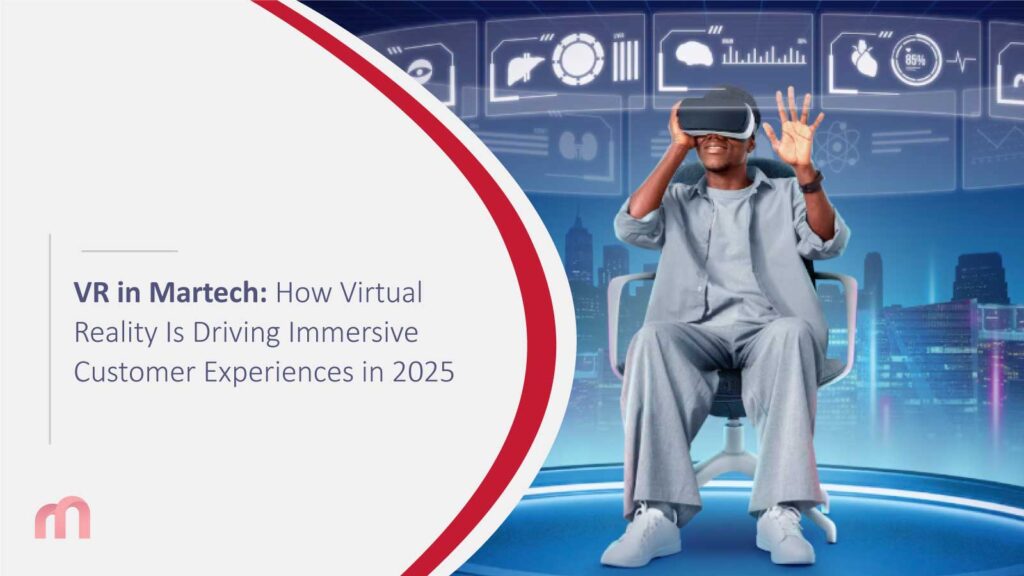
Let us say you are shopping for a new car online. Instead of viewing 2D images, you put on your VR headset, and now you are in the driver’s seat. You can feel the engine rumble, you can feel the texture on the steering wheel, and you are evaluating the interior as if you just bought it off the lot. This is not science fiction; this is the potential of VR in MarTech 2025.
Virtual Reality has come a long way since its beginning in gaming arcades and specialized tech demonstrations, to becoming one of the most powerful Marketing Technology (MarTech) tools. It is now shaping how brands are interacting with consumers since passive scrolling is being replaced by engaging experiences.
But here’s the key: VR isn’t just about “cool tech.” It’s about creating memorable, emotional, and personal customer journeys that drive engagement, loyalty, and yes, conversions. In this article, we’ll unpack how VR is being adopted in MarTech, the data behind its rise, and real-world applications transforming industries. By the end, you’ll see why VR isn’t just an add-on, it’s the future of customer experience.
Why VR in MarTech Matters in 2025
Customers in 2025 have ever-higher expectations. They do not require advertisements; they require experience – PwC research.
Businesses that spend money on immersive technologies like VR see their brand recall increase by 15% and purchase intent rise by 25% versus normal campaigns.
Why? Because VR short-circuits digital clutter. It’s easy to blink an ad out of existence, but traipsing into branded VR space? That sticks.
And businesses are taking note. A Statista report values the global market for VR at over $22 billion in 2025, and most of that slice will go toward marketing and retail experiences. This isn’t a trend; this is mainstream traction.
So what makes VR in MarTech so fascinating? Three words: immersion, personalization, and interactivity.
Immersion: From Storytelling to Story-Living
Marketers have traditionally been a storytelling profession. VR takes that work to story-living.
Consider a travel company such as Delta Airlines. Instead of a glossy brochure, they take you on a journey into a realm of the virtual in which you can “walk” through a first-class cabin, see legroom, and even catch a glimpse of in-flight menus. Clients don’t just read about comfort; they feel it.
Retailers are innovators as well. Furniture giants IKEA and Wayfair will be enhancing VR showrooms in 2025, where shoppers can furnish and enter their dream living room virtually before they hit “buy.” The payback? More confidence, less return, and an enhanced emotional connection to the brand.
Ask yourself: Would you drive your car, dream house, or trip if you could do that beforehand?
Personalization: Making Every VR Experience Unique
Maybe the most exciting aspect of VR in MarTech is how it’s merging immersion with data-driven personalization.
Following AI-powered MarTech platforms (hello, Salesforce, HubSpot, and Adobe), VR experiences are no longer monolithic. Here are some instances:
- Retail: A shopper checking out sportswear is offered a VR experience of a gym since they’ve been interested in fitness.
- Real estate: A homebuyer walks through houses with floor plans tailored to their preferences.
- B2B marketing: A software company creates VR product demos that highlight features most relevant to a specific client’s industry.
A McKinsey article from 2023 suggests even higher figures, with personalization boosting revenue by 5% to 15% and increasing marketing ROI by 10% to 30%.
And that is the beauty of it – VR enables customers to co-create their experience. They’re not just sitting in on a tale being spun; they’re living it. That kind of control is marketing gold.
Interactivity: The Engagement Multiplier
Where immersion buys attention and personalization wins trust, interactivity drives action.
Whereas ad formats such as print and TV are designed to be looked at, VR is designed to be engaged with. That can include:
- Watching a VR product demo before buying.
- Participating in a branded mini-game within a trade show booth.
- Shopping in a virtual pop-up store with clickable merchandise that directs customers to checkout.
For B2B businesses, interactivity has equally persuasive implications. A company like HCL Unica can schedule VR-capable product demos, where would-be purchasers interact with dashboards in a simulated environment, no driving involved.
And then there’s where humor gets in the way: recall the last time you endured a standard webinar. Clicking through slides, multitasking with email in the background, obedient nodding. Contrast with a VR webinar where you could go up to a virtual booth, shake hands with an avatar, or even socialize in breakout “rooms.” Which will be more likely to remain stuck in your head?
Industries Leading the VR Marketing Wave
Let’s have a look at where VR is already making waves in 2025:
- Retail & E-Commerce: Virtual fitting rooms allow customers to try on garments without entering a store. Beauty brands such as Sephora use VR mirrors so customers can virtually test makeup colors.
- Real Estate & Architecture: Homebuyers see houses covering states or continents without ever leaving the couch. Architects use VR to share projects before they are constructed.
- Automotive: Audi and Tesla, for instance, have virtual showrooms where customers “sit inside” models. VR driving simulations allow test drives without ever entering a dealership.
- Travel & Hospitality: Hotels offer VR tours of rooms, beaches, and facilities. Tourism boards let visitors “experience” places before they book.
- Events & Trade Shows: VR booths bring global exposure without the logistical challenge of live events. Hybrid events combine in-person and virtual attendees without interruption.
These are not hypothetical applications; they’re already reshaping the way customers browse, engage, and buy.
The Human Factor: Why VR Feels So Strong
And here is the best part: VR works because it plays on human psychology.
Your mind thinks that experiences in VR are real. Stanford’s Virtual Human Interaction Lab did a study that found people remember VR experiences better than they remember old-fashioned media. That is to say that if your business creates an amazing VR experience, it is embedded deeper in your customer’s brain.
And come on, there is a play element involved. VR is fun. Whether it’s vacationing in an imagined destination or “trying on” sneakers, VR substitutes passive scrolling with play. And who does not want some play, even on the most hectic workday?
What’s in Store for VR in MarTech
Looking forward, expect VR to further evolve with AI, AR (Augmented Reality), and voice. Consider VR experiences that adapt dynamically in response to customer emotions derived through biometric feedback. Or VR campaigns on social media for seamless discovery-to-purchase.
A Gartner prediction: By 2026, 25% of people will spend at least an hour a day inside immersive environments for work, shopping, education, or play. Individuals starting to invest now will not only be riding the wave, they’ll be shaping it.
Conclusion
Virtual reality in MarTech is not a far-off “nice-to-have.” For 2025, it’s a strategic necessity. Those companies that tap the immersive potential of VR will build deeper customer bonds, enhance engagement, and stand out in overcrowded markets.
So, is VR in marketing or not? It’s not whether VR belongs in marketing;g, it’s whether your business is prepared to invite customers into its universe. Because marketing fundamentally isn’t selling; it’s about making experiences last.
FAQs
1. How is VR different from AR for marketing?
VR builds complete virtual worlds, while AR overlays computer graphics on the real world. They are both applied in marketing in different ways, although VR is best for interactive, immersive experiences.
2. Is VR marketing within reach of small businesses in 2025?
Yes. The cost of VR tools fell dramatically. Most platforms include subscription-based VR marketing solutions accessible to SMBs.
3. Which industries reap the most benefits from VR in MarTech?
Retail, real estate, automotive, travel, and events lead the way, but essentially any business with customer engagement in mind stands to gain.
4. Is VR marketing always done through the use of a headset?
Not necessarily. Most campaigns nowadays execute in web-based VR platforms that one can view on desktops as well as smartphones, so they’re more accessible.
5. How does VR enhance customer engagement?
VR holds customers as active participants instead of passive observers, and that enhances recall, attention, and emotional identification with the brand.
Discover the trends shaping tomorrow’s marketing – join the leaders at MarTech Insights today.
For media inquiries, you can write to our MarTech Newsroom at news@intentamplify.com